Brilliant Galley Kitchen Ideas to Maximize Style and Storage in Narrow Spaces
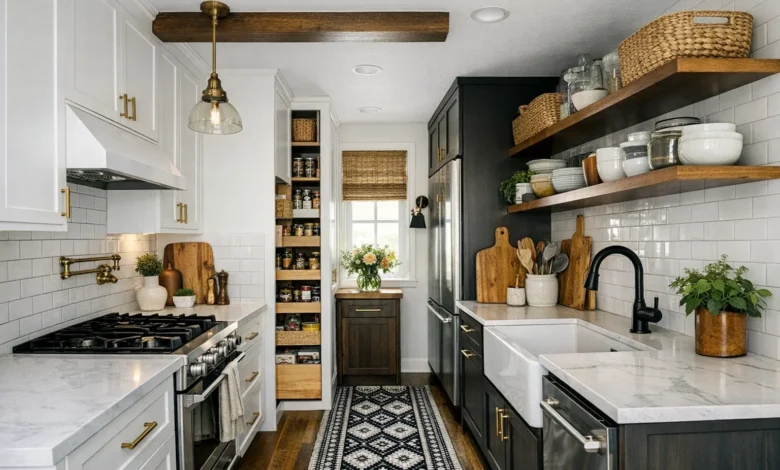
Brilliant Galley Kitchen Ideas: Let’s be real for a second—when most people hear “galley kitchen,” they picture a cramped, dark corridor where you bump elbows with the oven mitts. But that old stereotype is dead wrong. In fact, a well-planned galley kitchen can be one of the most efficient, beautiful, and even social spaces in your home. Think of it like the cockpit of a commercial airplane: every switch, dial, and surface is within arm’s reach. No wasted steps. No awkward dead zones. Just pure cooking flow.


The magic of galley kitchen ideas lies in their simplicity. Two parallel countertops (sometimes one wall and an island, but classically two facing walls) create a natural workstation triangle between your sink, stove, and refrigerator. This layout isn’t just for tiny apartments or vintage row homes anymore. Modern designers are embracing the galley for luxury condos, open-concept homes, and even outdoor kitchens because it forces intentionality. You can’t just throw in a massive island and call it a day. You have to think about vertical storage, traffic patterns, and lighting in ways that make the final result feel custom and clever.
In this guide, we’ll walk through over a dozen actionable galley kitchen ideas—from budget-friendly DIY tweaks to full-renovation inspirations. We’ll cover layout mistakes to avoid, smart storage solutions that’ll make you grin every time you open a drawer, and how to inject personality without cluttering your narrow workspace. Whether you’re working with a 5-foot-wide hallway or a surprisingly roomy 12-foot passage, these strategies will help you cook, entertain, and live better. Let’s dive in.
What Exactly Defines a Galley Kitchen and Why It Works
First things first: a galley kitchen is defined by two parallel runs of cabinetry or counters, with a walkway in between. The name comes from ship galleys—the tight but ruthlessly efficient cooking spaces on boats. And just like on a vessel, every inch matters. Most galley kitchens range from 4 to 9 feet wide (measured between counter edges) and are often enclosed at one or both ends. Some newer interpretations use one solid wall and a partial wall on the other side, but the core principle remains: a linear workflow with minimal cross-traffic.
Why does this layout work so well? Human factors research in kitchen design consistently shows that the galley reduces unnecessary steps. In an L-shaped or U-shaped kitchen, you might walk an extra 30 to 50 feet just to grab a spoon. In a galley, you turn 90 degrees left or right. That’s it. This efficiency is a godsend for anyone who cooks daily—from busy parents to passionate home chefs. Plus, because the counters face each other, you can set up a “landing zone” on one side and a “cooking zone” on the other, keeping raw ingredients and hot pans safely separated.
Another underrated win? Galley kitchens naturally encourage a single-file traffic flow. That means no more family members cutting through your cooking space to grab a soda from the fridge. If you design the pass-through correctly (for example, by closing off one end or adding a pocket door), you create a dedicated cooking zone that feels like a professional prep kitchen. For open-plan homes, a galley can even act as a subtle room divider between the living area and dining space. The key is embracing the narrowness instead of fighting it.
Smart Space Planning – The Golden Ratio for Galley Walkways
Before you pick out a single tile or cabinet pull, measure your walkway. This is where most galley kitchen ideas fail or flourish. The industry standard for a comfortable one-cook kitchen is 42 inches between counter edges. If you have two people who often cook together, aim for 48 inches. Anything under 36 inches will feel like a cramped airplane aisle—you’ll constantly shuffle sideways to open the oven or dishwasher. Conversely, if your walkway exceeds 54 inches, you lose the efficiency advantage and might as well consider a different layout.
But here’s the expert trick: those measurements assume standard 24-inch deep base cabinets on both sides. If you’re willing to use shallower cabinets on one wall (say, 18 or 21 inches deep), you can shrink the overall room width without feeling squeezed. This is a lifesaver for vintage homes or converted garages. Another pro move is to replace one run of lowers with open shelving or a 15-inch deep counter (perfect for coffee stations or small appliances). Suddenly, that 8-foot wide room becomes a luxurious galley with breathing room.
Traffic flow is the second part of the puzzle. If your galley has doorways at both ends, it becomes a pass-through corridor. That’s fine for families who move between rooms often, but you’ll need to keep the path clear. Consider shifting the refrigerator to the end of one run so it doesn’t block the flow. If you have only one entrance (a dead-end galley), you gain the ability to use the far wall for deep storage, a second sink, or even a petite banquette. Think about how your household moves during a typical dinner rush—that will tell you the right orientation.
Vertical Storage Solutions That Transform Narrow Galley Kitchens
When floor space is at a premium, you look up. And I mean way up. Floor-to-ceiling cabinets are your best friend in a galley kitchen. Most stock cabinets stop at 36 or 42 inches tall, leaving a dusty gap above. Instead, order custom or semi-custom uppers that reach the ceiling—or add a second tier of smaller cabinets above your main ones. This creates a place for holiday platters, stockpots, and that bread machine you use twice a year. Use a rolling library ladder (yes, even in a galley) to access the top tier, and suddenly your kitchen feels like a chic Parisian apartment.
Open shelving gets a mixed reputation in galley designs, but it can work beautifully if you’re disciplined. Reserve one wall’s upper section for open shelves, and use them only for everyday items like white plates, glass jars of pasta, and your favorite mugs. The visual break between solid cabinets and open shelves prevents the “tunnel” effect. Just avoid cramming shelves with mismatched Tupperware or cereal boxes—that creates visual clutter in a narrow space. Stick to a uniform color palette and leave 20% of each shelf empty for breathing room.
Don’t forget the often-ignored space above the refrigerator. A custom cabinet built around your fridge (with proper ventilation gaps) can store baking sheets, cutting boards, or even a pull-out spice rack. Similarly, the toe-kick area below your base cabinets can be converted into shallow drawers for cookie sheets, pet bowls, or flatware. These hidden storage hacks are the unsung heroes of brilliant galley kitchen ideas. And if you have a bulkhead or soffit, consider removing it to gain another 12 to 18 inches of vertical storage—just check for wiring or ducts first.
“A galley kitchen is like a sonnet—the constraints force you to be more creative. When every inch has a purpose, you stop buying clutter and start loving what you own.” – Anonymous kitchen designer.
Lighting Tricks to Make a Galley Kitchen Feel Twice as Wide
Poor lighting is the number one reason galley kitchens feel like dungeons. You’ve got two long walls and a narrow ceiling—shadow central. The fix is layered lighting, not just a single overhead fixture. Start with recessed LED lights down the center of the ceiling, spaced every 4 to 5 feet. But here’s the pro tip: install them on two separate dimmer switches. One switch controls the lights over the sink/prep zone, another controls the lights over the cooking zone. This lets you create “zones” of brightness that break up the long visual line.
Under-cabinet lighting is non-negotiable in a galley. Without it, your countertops become dark caves because your body blocks the overhead light. Choose hardwired LED tape lights or puck lights with a low profile (less than half an inch thick). Mount them toward the front edge of the upper cabinets so they illuminate the backsplash and counter, not the wall. Warm white (2700K to 3000K) makes food look appetizing; cool white (4000K) is better for task lighting but can feel clinical. I recommend a dimmable warm white for most homes.
Finally, add a reflective backsplash to bounce light around. Glossy white subway tile, mirrored glass, or even high-gloss stainless steel panels can double the perceived brightness. If you have a window at one end of the galley, keep it completely unobstructed—no curtains, no bulky blinds. A simple roller shade or frosted film preserves privacy without killing natural light. For windowless galley kitchens, install a large mirror at the far end; it creates the illusion of a window and visually extends the walkway.
Countertop Materials That Balance Durability and Flow
Your choice of countertop in a galley kitchen matters more than in any other layout because the surfaces are long, continuous, and highly visible. Seams become a big deal. For that reason, quartz is a top contender—it comes in large slabs (up to 120 inches), so you can often cover an entire run with zero seams. Quartz is also non-porous, meaning red wine or tomato sauce won’t stain, and you never need to seal it. The downside? It can look slightly artificial if you choose a heavily veined pattern. Stick to fine, subtle speckles or solid matte finishes for a timeless look.
Butcher block is a fantastic budget-friendly option that adds warmth to narrow galley kitchen ideas. The trick is to orient the wood grain perpendicular to the length of the counter—this makes the space feel wider, like horizontal stripes on a sweater. Seal it with a food-safe hard wax oil (like Osmo or Rubio Monocote) to prevent water rings. Expect to lightly sand and re-oil every year or two. If that maintenance sounds annoying, consider a butcher block only on the non-sink side, and use quartz or granite around the sink.
For the truly bold, consider a single slab of polished concrete or soapstone. Both materials develop a beautiful patina over time, and they’re heat-resistant enough to set a hot pan directly on the surface. However, concrete requires professional sealing every few years, and soapstone can scratch (though scratches are easily buffed out). Avoid highly polished granite in a galley—the reflections can create disorienting glare, especially with under-cabinet lights. A leathered or honed finish is more forgiving and hides fingerprints beautifully.
| Material | Pros for Galley | Cons | Best For |
| Quartz | Seamless long runs, no sealing, stain-resistant | Can look artificial; not heat-proof | Busy family kitchens |
| Butcher Block | Warmth, budget-friendly, easy to cut on | Requires yearly oiling; can water-stain | Eco-friendly or farmhouse styles |
| Soapstone | Heat-proof, develops patina, non-porous | Soft (scratches easily), limited colors | Vintage or industrial designs |
| Polished Concrete | Ultra-durable, seamless, modern | Heavy; needs professional sealing | Minimalist or loft aesthetics |
| Laminate | Cheap, endless colors, low maintenance | Can burn or peel; seams visible | Rental apartments or tight budgets |
Cabinet Colors and Finishes to Open Up the Walkway
Color psychology is real, especially in a narrow galley. Dark cabinets absorb light and make the walls feel like they’re closing in. That doesn’t mean you can’t use charcoal or navy—just restrict them to lower cabinets only. Pair dark bases with white or light gray uppers. This “two-tone” approach draws the eye upward and creates a sense of height. Another clever trick: paint the cabinets at the far end of the galley a slightly lighter shade than the ones near the entrance. That gentle gradient tricks the brain into perceiving more depth.
White on white is the classic choice for a reason. But pure bright white can feel sterile. Try off-whites with warm undertones—Swiss Coffee, White Dove, or Alabaster. Then add contrast through hardware and backsplash. For a more modern take, consider pale sage green, powdery blue, or even a blush pink on the lower cabinets. These colors still reflect light but add personality. Just keep the upper cabinets white to maintain that airy feel.
If you’re renovating a rental or don’t want to commit to paint, consider peel-and-stick vinyl film for cabinet fronts. High-quality films (like from d-c-fix or WallPops) can mimic linen, wood grain, or solid colors and last three to five years. It’s a low-risk way to test bold galley kitchen ideas without angering your landlord. And don’t forget the ceiling—painting the ceiling a shade lighter than your walls (or even glossy white) bounces light down onto your counters.
Space-Saving Appliances Perfect for Galley Layouts
Full-size refrigerators and ranges can work in a galley, but you’ll need to choose carefully. Counter-depth refrigerators are practically mandatory—they sit flush with your cabinets instead of sticking out 4 to 6 inches into the walkway. Yes, you lose a little interior capacity, but the improved traffic flow is worth it. Look for models with the freezer on the bottom, because side-by-side doors require more clearance to open fully. And please, avoid French door fridges with external ice makers; those bulky handles will catch your hips constantly.
For the cooktop, consider a 30-inch induction model. Induction heats faster than gas, is safer (no open flame in a tight space), and the flat glass surface doubles as extra prep space when turned off. Pair it with a slim under-cabinet range hood that’s no more than 12 inches deep. If you can’t vent outside, a high-quality recirculating hood with charcoal filters is acceptable, but try to duct outside if possible—galley kitchens trap cooking odors easily.
Dishwashers are another potential squeeze. An 18-inch wide dishwasher (instead of the standard 24-inch) holds enough plates for two to four people and frees up precious inches for a pull-out trash bin or narrow spice rack. Likewise, consider a microwave drawer installed in the lower cabinet run. It keeps your counters completely clear and is far more ergonomic than a microwave above the range (which forces you to reach over hot burners). These appliance swaps are the kind of galley kitchen ideas that feel luxurious without a massive budget.
Sink and Faucet Placement for Maximum Workflow
Where you put the sink can make or break your galley. The classic rule: sink on one run, cooktop on the opposite run, and refrigerator at one end. This creates a perfect work triangle with no single leg longer than 9 feet. However, if you often wash large pots or sheet pans, avoid placing the sink in a corner. A corner sink eats up counter space and forces you to twist your back. Instead, center the sink between two base cabinets, with at least 18 inches of landing space on each side.
An undermount single-basin sink (at least 27 inches wide) is superior to double basins in a galley. You can wash a roasting pan flat, and you never have to balance dirty dishes in a small second bowl. Add a grid rack at the bottom to protect the sink finish and a roll-up dish drying rack that stores away when not in use. For the faucet, choose a high-arc pull-down model with a magnetic docking head. The high arc clears tall stockpots, and the pull-down sprayer makes rinsing easy without splashing water everywhere.
One sneaky trick: install a pot filler faucet directly above your cooktop on the opposite wall. This requires running a water line inside the wall, but it means you never carry heavy pots of water across your galley. If you have the budget, a filtered drinking water faucet next to the main sink also reduces trips to the refrigerator for water. These small luxuries make your galley kitchen ideas feel custom and thoughtful.
Creative Backsplash Ideas That Add Depth Without Clutter
The backsplash is your chance to add pattern and personality without taking up an inch of floor space. In a galley, avoid large, busy mosaics—they can feel overwhelming when you’re standing just 3 feet away. Instead, try horizontal subway tile laid in a running bond pattern. The horizontal lines visually widen the room. For a more modern look, use 4×12-inch tiles stacked vertically; this emphasizes height and draws the eye upward, making the ceiling feel loftier.
If you love color but fear commitment, install a peel-and-stick backsplash in a subtle geometric pattern. Brands like Smart Tiles or Art3D offer removable options that look like real ceramic. Another clever idea: use the same countertop material as a 6-inch tall backsplash (creating a seamless monolith) and then paint the wall above with a high-gloss enamel. That painted surface is surprisingly easy to wipe clean, and you can change the color anytime without retiling.
For the truly adventurous, consider a magnetic backsplash made from sheet metal (stainless steel or pre-painted magnetic receptive panels). You can attach magnetic spice tins, knife strips, or even small whiteboards for grocery lists. It’s a functional art piece that plays perfectly into galley kitchen ideas focused on utility. Just seal the metal with a clear coat if you choose raw steel, or it may rust near the sink.
Flooring Choices That Enhance the Sense of Flow
Flooring in a galley kitchen needs to be durable, easy to clean, and—most importantly—visually continuous. Avoid busy patterns or large-scale tiles that get broken up by cabinets. The best choice? Long plank flooring (vinyl, laminate, or engineered wood) is laid parallel to the length of the room. Those long lines act like runway stripes, pulling the eye from one end to the other and making the space feel longer and wider. Choose planks at least 5 inches wide to reduce the number of seams.
If you love tile, use large-format rectangles (12×24 inches or larger) in a staggered brick pattern. Again, orient the long side parallel to the counters. Grout color should be as close to the tile color as possible—high-contrast grout creates a grid pattern that visually chops up the floor. For a seamless look, consider polished concrete or micro-topping (a thin layer of cement applied over your existing subfloor). It’s not cheap, but the monolithic finish is stunning in a narrow galley.
One warning: stay away from checkerboard floors, herringbone patterns, or small hexagon tiles. These all create visual vibration in a tight space. And if you have a galley that opens into a living room, carry the same flooring throughout both spaces. A threshold or transition strip visually cuts the room in half, making the kitchen feel smaller. Continuous flooring is one of those simple galley kitchen ideas that professional designers use all the time.
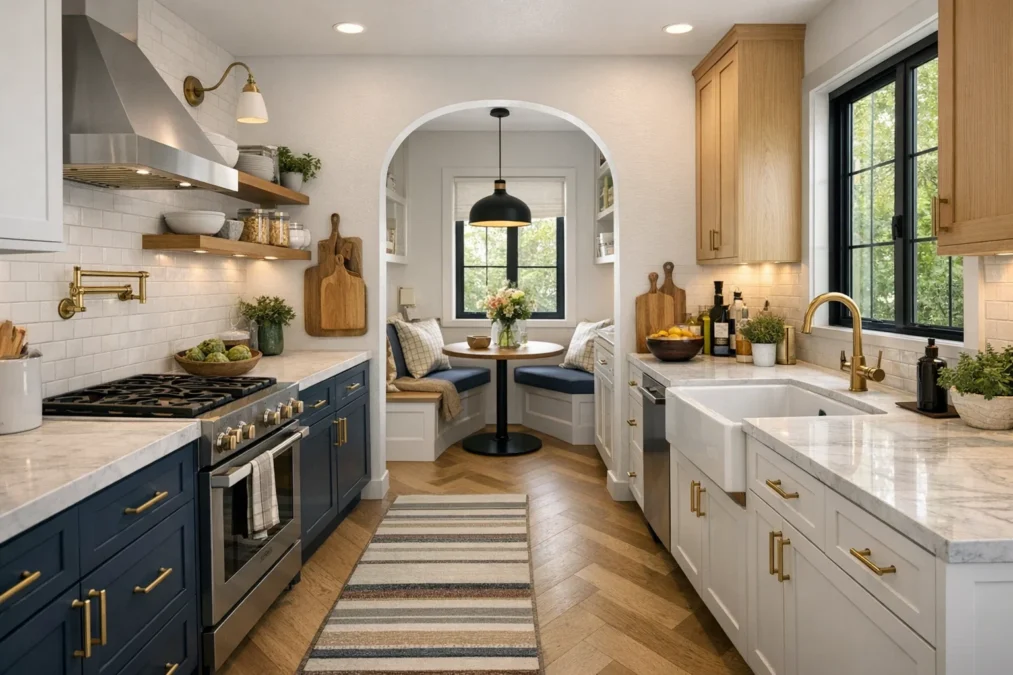
Adding Personality Without Clutter – Art, Plants, and Textiles
Just because your kitchen is narrow doesn’t mean it has to be boring. The trick is to add personality in vertical or shallow forms. A single large piece of art hung at eye level on the far end wall can become a focal point, drawing attention away from the length of the room. Choose a canvas with a landscape that has horizontal lines (like a horizon or a field) to reinforce the sense of width. Avoid heavy frames—floating canvases or thin metal frames keep the look light.
Plants are your best friend in a galley. A trailing pothos or string of pearls on top of your upper cabinets softens the hard lines of cabinetry. Or install a slim magnetic planter on your refrigerator side. Herbs like basil, mint, and thyme thrive in a sunny window and smell amazing when you brush past them. Just avoid large floor plants—they’ll block the walkway. Instead, use a wall-mounted terrarium or a slim ceramic pot on the counter near the sink.
Textiles add warmth but can also add bulk. A single runner rug (2×6 or 2×8 feet) down the center of the walkway is perfect. Choose a low-pile or flatweave rug so the dishwasher or oven door can slide over it easily. Avoid multiple small rugs or mats—they create tripping hazards. For window treatments, a simple roller shade or Roman shade in a neutral linen keeps things clean. Skip curtains altogether; they’ll dangle into your work zone.
Galley Kitchen with an Island – Yes, It’s Possible
I know what you’re thinking: “An island in a galley? That defeats the whole point.” But hear me out. If your galley is wider than 11 feet (counter to counter), you can actually insert a narrow, wheeled island or a fixed peninsula that extends from one wall. The key is keeping the island shallow—no more than 24 inches deep, and ideally just 18 inches. This gives you extra prep space and storage while still leaving a 36-inch walkway on at least one side.
A mobile butcher block cart on locking casters is the smarter move for most homes. Roll it against the wall when you need floor space, then pull it into the center when you’re chopping vegetables or serving buffet-style. Look for carts with open shelving below (for cookbooks or baskets) rather than closed cabinets, which feel heavy. And make sure the cart height matches your countertops (standard 36 inches) so it can double as a landing zone next to the stove.
If you truly want a fixed island, consider a “breakfast bar” peninsula that attaches to one wall at a 90-degree angle, extending only 4 feet into the room. This leaves the rest of the galley open for traffic. Add two barstools on the living room side, and suddenly your galley becomes a social hub. Just be brutally honest about your space—measure three times, and do a cardboard mock-up on the floor. Nothing kills galley kitchen ideas faster than an island that turns your walkway into a crawlspace.
Budget-Friendly Galley Makeovers Under $1000
Not everyone has $30k for a full renovation. The good news? You can transform a tired galley for under a grand with some sweat equity. Start with the hardware: new cabinet pulls and hinges cost around $100 to $200. Choose slim bar pulls or cup pulls—they don’t snag on clothing like bulky knobs. Next, replace your faucet with a $150 high-arc model from a brand like Moen or Delta. That single swap instantly modernizes the whole room.
Paint is your cheapest weapon. For $50 in primer and paint, refresh your cabinets (use a bonding primer and semi-gloss enamel). Or paint just the lower cabinets a bold color and leave the uppers white. Another $30 buys a peel-and-stick backsplash; you can install it in an afternoon. Finally, upgrade your lighting. Swap a boob light for a $70 LED flush mount, and add $40 battery-operated stick-on lights under your cabinets. Total cost: around $400, and it looks like a $5,000 makeover.
For the remaining budget, buy organizational inserts. Pull-out shelves for base cabinets ($30 each), a lazy Susan for corner cabinets ($25), and stackable wire racks for your upper cabinets. Also invest in a magnetic knife strip ($15) and a pegboard wall ($20) for hanging pots. These small changes reduce clutter so your existing galley kitchen ideas can shine without major construction.
Common Galley Kitchen Mistakes and How to Avoid Them
Let’s talk about what goes wrong. The most frequent mistake is blocking the walkway with appliance doors. Before you buy a refrigerator, open its door in the showroom and measure how far it swings. French door fridges need 40 inches of clearance to open fully. In a 48-inch galley, that leaves just 8 inches for you to stand—impossible. Solution: buy a fridge with a door that can reverse to open against a wall, or choose a single-door model.
Mistake number two: insufficient counter space next to the cooktop and sink. You need at least 15 inches on one side of the cooktop for a saucepan and 18 inches on the other side for a cutting board. For the sink, 18 inches on the dominant side (usually the right for right-handers) to stack dirty dishes. If your galley doesn’t have these dimensions, consider adding a rolling cart or a flip-up counter extension. Yes, they make hinged countertops that fold down when not in use.
The third killer mistake is ignoring ventilation. Galley kitchens trap steam, smoke, and cooking smells because air doesn’t circulate well. A recirculating range hood isn’t enough if you cook with high heat or lots of spices. Install a ducted hood that vents outside, and make sure it’s at least as wide as your cooktop. If ducting is impossible, add a ceiling exhaust fan and crack a window while cooking. Your future self will thank you when your kitchen doesn’t smell like last night’s fish.
Real-Life Galley Kitchen Layout Examples (With Measurements)
Theory is great, but let’s get concrete. Example one: a 6-foot-wide by 12-foot-long galley in a 1920s bungalow. The walkway is 48 inches between counters. On one wall: a 30-inch sink base, then 24 inches of counter, then a 30-inch induction cooktop, then another 18 inches of counter. Opposite wall: a 36-inch counter-depth fridge at the far end, then 30 inches of counter, then an 18-inch dishwasher, then 24 inches of open shelving. This leaves 12 inches at the near end for a trash pull-out. Perfect for two cooks.
Example two: a super-narrow 5-foot-wide galley in a city apartment. The walkway is just 36 inches. Here, you must go shallow. One wall gets 18-inch deep base cabinets with a 24-inch farmhouse sink. The opposite wall gets 15-inch deep open shelves (no lowers) with a 24-inch cooktop and a microwave drawer below. The refrigerator is a 24-inch wide, counter-depth model placed at the far end. Upper cabinets are only 12 inches deep to avoid hitting heads. This works for one cook at a time.
Example three: an open-concept galley that separates a living room from a dining area. The galley is 10 feet wide but only 8 feet long. One wall is full-height cabinets with an integrated fridge and oven. The “second wall” is actually a 4-foot-tall peninsula with bar seating on the living room side. The walkway is 42 inches between the peninsula and the full wall. This layout gets you galley efficiency plus social seating. Adapt these galley kitchen ideas to your actual dimensions, and you’ll avoid expensive mistakes.
Future-Proofing Your Galley Kitchen with Smart Tech
Smart home tech can make a narrow galley feel like the bridge of the Starship Enterprise. Start with a smart plug for your coffee maker or kettle—schedule it to turn on 10 minutes before you wake up. Next, install a motion-sensor light strip inside your walk-in pantry or under the sink. It turns on automatically when you open the door, so you’re never fumbling in the dark.
Voice-controlled faucets (like the Moen Smart Faucet) let you dispense exact amounts of water—say “Hey Google, pour 2 cups of boiling water” and walk away. For safety, add a smart smoke/CO detector with a voice alert that tells you where the problem is (e.g., “Smoke detected in the kitchen”). And a smart leak sensor under the sink and dishwasher can shut off your main water valve via an automatic shutoff like the Moen Flo.
Finally, consider a smart refrigerator with an interior camera. You can check what’s inside the grocery store using your phone. In a galley kitchen, it saves you from opening the fridge door and blocking the walkway while you stare blankly at the shelves. None of these require a full renovation—they’re plug-and-play upgrades that make your galley kitchen ideas feel futuristic and functional.
Conclusion
A galley kitchen isn’t a compromise—it’s an opportunity. When you embrace the narrow footprint, you unlock a level of efficiency and intentionality that sprawling open-concept kitchens often lack. The best galley kitchen ideas focus on three pillars: vertical storage to reclaim lost space, layered lighting to banish shadows, and smart appliance choices that keep the walkway clear. Whether you’re working with a shoestring budget or planning a luxury remodel, the principles remain the same. Measure your walkway obsessively. Choose countertops and floors that create visual length. And never, ever block your work triangle with a fridge door.
Remember that your galley can be beautiful, too. Soft colors, a single piece of art, and a runner rug add warmth without clutter. If you love to cook, you’ll appreciate having everything within two steps. If you love to entertain, a galley actually forces guests to hang out in the living room (where they belong) while you work your magic. So stop mourning the lack of a giant island. Instead, celebrate the galley for what it is: the hardest-working, honest, and clever kitchen layout ever designed. Now go measure your space and start planning your transformation.
What is the ideal width for a galley kitchen walkway?
The ideal walkway width is 42 inches for one cook and 48 inches for two cooks working simultaneously. This allows cabinet doors and appliance doors to open without hitting the opposite counter. If your space is narrower than 36 inches, consider removing one run of base cabinets and replacing them with open shelves or a shallow 15-inch counter. Anything over 54 inches loses the efficiency benefits of a galley.
Can you put an island in a galley kitchen?
Yes, but only if the total room width (counter to counter) exceeds 11 feet. The island must be shallow—no more than 24 inches deep—and should be on locking casters so you can move it against a wall when not in use. Fixed islands are rarely successful in true galley kitchens because they block the walkway. A better alternative is a rolling butcher block cart that doubles as prep space.
What are the best countertops for a galley kitchen?
Quartz is the top choice for seamless long runs, durability, and stain resistance. Butcher block adds warmth but requires yearly sealing. For a budget option, high-pressure laminate with a matte finish works well. Avoid heavy patterns or high-gloss finishes that create glare. The most important factor is minimizing seams—look for slabs long enough to cover your entire counter run without a break.
How do you light a galley kitchen without windows?
Use three layers of light: recessed LEDs down the center of the ceiling (on two separate dimmers), under-cabinet task lights at the front edge of upper cabinets, and accent lights (like small picture lights) on the far end wall. Add a large mirror at the end of the galley to reflect both natural and artificial light. Choose bulbs with a color temperature of 3000K for a balance of warmth and visibility.
H3: Are galley kitchens outdated?
Not at all. Galley kitchens are experiencing a renaissance because modern homeowners value efficiency and workflow over cavernous spaces. High-end architects frequently use galley layouts in luxury condos and vacation homes. The key is updating them with contemporary materials (like quartz and induction cooktops), smart storage, and layered lighting. A well-designed galley feels timeless, not dated.
What’s the cheapest way to update a galley kitchen?
Paint the cabinets (under $100), replace hardware (under $100), add a peel-and-stick backsplash ($50 to $150), install under-cabinet battery lights ($40), and swap the faucet ($150). Total around $500. For flooring, vinyl plank stickers over existing tile cost $200 to $300. Avoid moving plumbing or electrical—that’s where costs spiral. These cosmetic changes deliver 80% of the visual impact for 10% of the cost of a full renovation.