Mastering the Word Count on Google Docs: Your Ultimate Guide to Tracking and Managing Text
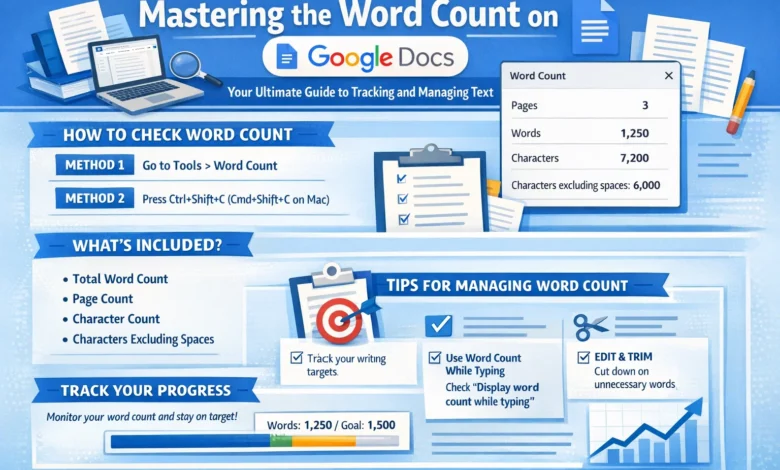
Word Count on Google Docs: In the modern digital landscape, where precision and clarity often hinge on meeting specific textual requirements, understanding the mechanics of your writing tools is non-negotiable. Whether you are a student racing to meet an essay limit, a novelist meticulously crafting a chapter, or a marketer developing a concise social media campaign, the word count on Google Docs is the silent gatekeeper of your success. It is more than just a number at the bottom of the page; it is a real-time feedback mechanism that informs your pacing, structure, and overall narrative flow.
Google Docs has revolutionized how we create and collaborate, offering a cloud-based platform that prioritizes accessibility and ease of use. However, despite its intuitive design, many users barely scratch the surface when utilizing the built-in analytics. We often find ourselves manually estimating lengths or pasting text into external counters, unaware that the solution is literally built into the toolbar. This guide aims to demystify every facet of the word count on Google Docs, ensuring that you not only find the number of words you have written but also leverage this data to become a more efficient and effective writer. From the basic “Tools” menu, click on the advanced strategies for collaboration. We will cover it all in a casual yet expert tone that transforms you from a Docs novice into a power user.
The Quintessence of Word Counting
Before diving into the “how,” it is crucial to explore the “why.” The importance of word count transcends mere compliance with arbitrary rules. It is a fundamental aspect of communication theory and audience engagement. Think about it: a blog post of 300 words serves a different purpose than a white paper of 3,000 words. The former aims for quick engagement and scannability, while the latter is designed for deep analysis and comprehensive coverage. When you actively monitor the word count on Google Docs, you are engaging in a dialogue with your audience’s attention span.
Furthermore, in professional and academic spheres, word limits are often tied to cost, time, and readability. A conference proposal might have a strict 150-word abstract limit because organizers have hundreds of submissions to review. Exceeding that limit could result in immediate disqualification. Similarly, in the publishing industry, word count can determine the genre of your book; a fantasy novel might comfortably sit at 120,000 words, whereas a typical romance novel might hover around 80,000. Therefore, mastering the word count on Google Docs is not just about using a feature; it is about respecting industry standards and reader expectations. By keeping a live check on your progress, you ensure that your message is as long as it needs to be and as short as it has to be.
Accessing Word Count on Desktop Browsers
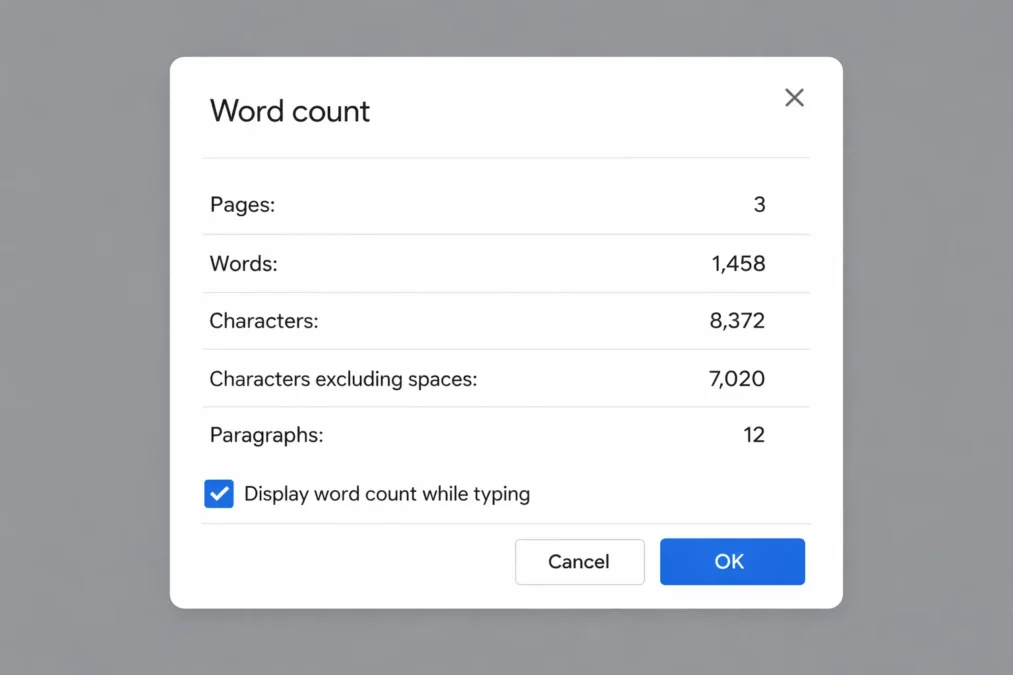
For the vast majority of users, the desktop experience remains the primary workspace. Whether you are using Chrome, Firefox, or Safari, Google Docs provides a seamless interface for tracking your document statistics. The most straightforward method to check the word count on Google Docs involves navigating through the top menu bar. Simply open your document, click on “Tools,” and then select “Word count” from the dropdown menu. A dialog box will appear, presenting you with a wealth of information: pages, words, characters (with and without spaces), and paragraphs.
However, the true magic for efficiency enthusiasts lies in the keyboard shortcut. If you are in the flow of writing, the last thing you want to do is lift your hands from the keyboard to grab the mouse. For Windows and ChromeOS users, pressing Ctrl + Shift + C will instantly summon the word count dialog. On macOS, the combination is Command + Shift + C. This shortcut is a game-changer for productivity, allowing you to check your progress in a fraction of a second without disrupting your creative rhythm. This immediate access ensures that you are never guessing how close you are to your target, making the word count on Google Docs a constant, reassuring presence.
Enabling the Live Word Count Display
While the dialog box is useful, constantly summoning it can become tedious. For those who prefer a “set it and forget it” approach, Google Docs offers an elegant solution: the live word count display. This feature places a small, unobtrusive counter in the lower-left corner of your document window, updating in real time as you type or delete text. To enable this, you need to access the word count dialog as described above (via Tools or the keyboard shortcut). At the bottom of that dialog box, you will see a checkbox labeled “Display word count while typing”.
Once you check that box and click “OK,” the counter remains active for that specific document. It is a fantastic motivational tool. Watching that number climb as you write provides a dopamine hit of progress, encouraging you to push through writer’s block to hit your daily goal. However, it is important to note a common user quirk regarding this feature. If you close the document and reopen it later, the live word count remains active. But if you open a brand new document, you will need to enable the live display again. This is by design, as the setting is saved on a per-document basis rather than as a global default, a point of confusion frequently discussed in user forums.
Managing Word Count on Mobile Devices
In our increasingly mobile world, productivity is no longer chained to a desk. You might be editing a report on your commute or drafting a blog post while waiting in line for coffee. Google Docs ensures that the word count is accessible regardless of your device. The mobile apps for Android and iOS, while slightly different in interface, offer robust word count features that mirror their desktop counterpart.
To find the word count on the mobile app, open your desired document and look for the three vertical dots (the menu icon) typically located in the upper-right corner of the screen. Tap this icon to open the menu and scroll down until you see the “Word count” option. Tapping it will display a pop-up window showing the total words, character count (with and without spaces), and page count. While the mobile version currently does not support the live, always-on display found on the desktop, the quick accessibility of the pop-up makes it easy to check your progress on the fly. This cross-platform consistency ensures that your relationship with the word count on Google Docs is seamless, whether you are on a laptop, tablet, or phone.
Counting Specific Sections of Text
One of the most versatile yet underutilized features of Google Docs is the ability to count words in a specific selection of text. This is incredibly useful for editors who need to ensure a particular paragraph doesn’t exceed a limit, or for students who are required to hit a word count for an individual section of a larger paper. The word count on Google Docs is intelligent enough to distinguish between the whole document and a highlighted portion.
To use this feature, simply click and drag your cursor to highlight the text block you wish to analyze. Then, access the word count dialog using either the Tools menu or the keyboard shortcut. The resulting pop-up will display two sets of numbers: one for your selection and one for the entire document. This dual display allows you to understand the composition of your work. For instance, if your introduction is too long, you can highlight it, see its exact word count, and trim it down accordingly. This granular control is essential for maintaining balance and structure in your writing, proving that the word count on Google Docs is not just a blunt instrument but a precise scalpel for refinement.
Understanding Inclusions and Exclusions
To truly master the word count on Google Docs, one must understand what is being counted and what is being ignored. This is where many users encounter surprises. Generally, Google Docs is excellent at counting the visible body text. However, it explicitly excludes certain elements by default. Specifically, text contained within headers, footers, and footnotes is not included in the standard word count.
This exclusion is logical for most academic writing, as footnotes are often citations or tangential thoughts. But it becomes critical to know if your institution or publisher requires footnotes to be included in the final tally. In that case, you would need to manually account for that text or temporarily move it into the body. Additionally, the way Google Docs handles URLs is interesting. If you paste a long, complex URL into your document, the system does not count the entire link as one word. Instead, it breaks the URL at punctuation points (like slashes or dots) and counts each segment as an individual word. A single link could artificially inflate your word count by five or six words, which is something to be mindful of if you are cutting it close to a limit.
Word Count vs. Character Count
While the term “word count” is the most commonly used metric, Google Docs also provides detailed character counts. This is an indispensable feature for professionals who write for platforms with strict character limits, such as Twitter (now X), SMS messages, or meta descriptions for SEO. When you open the word count dialog, you will see two distinct character figures: “Characters (no spaces)” and “Characters (with spaces)”.
The “with spaces” count is typically the most accurate representation of the physical space your text occupies. This is crucial for understanding visual density. For example, a tweet’s limit of 280 characters is based on the total count, including spaces. Therefore, the word count on Google Docs becomes a dual-purpose tool: it helps you manage your narrative length while also ensuring your text fits within technical constraints. For screenwriters or poets, character count can sometimes be a more relevant metric than word count, and having this data readily available enhances the versatility of Google Docs as a writing environment.
Advanced Management Strategies
Knowing the number of words is one thing; managing that number effectively is an art form. Experienced writers use the word count on Google Docs not as a passive metric but as an active tool for structuring their workflow. One effective strategy is to set micro-goals. If you have a 2,000-word article due by Friday, you can break that down into four 500-word writing sessions. By enabling the live word count display, you can focus solely on hitting that 500-word target before you stop for a break, making the larger project feel less daunting.
Another advanced strategy involves using the word count to combat “scope creep” in your writing. It is easy to go off on tangents and include information that, while interesting, is not strictly necessary for your thesis. By regularly checking the word count on Google Docs, you can identify when a section is becoming disproportionately long. This serves as a red flag, prompting you to ask: “Does this tangent serve the reader, or is it just filling space?” By using the word count as a guardrail, you keep your writing lean, mean, and focused on the core message, which ultimately leads to higher reader engagement and retention.
Collaboration and Word Count
Google Docs shines brightest as a collaborative tool, but teamwork can sometimes complicate the simple metric of word count. When multiple people are contributing to a single document, the word count on Google Docs becomes a dynamic figure that reflects the sum of everyone’s efforts. This can be useful for project managers who need to track overall progress. However, it can also obscure individual contributions.
To manage this effectively, use the “Suggesting” mode (located in the top-right corner, next to “Editing”). This allows collaborators to propose changes without altering the live document, giving the owner a chance to see how proposed edits would impact the final word count before accepting them. Additionally, if you need to track individual contributions, you might use the “Version History” (File > Version history > See version history). While this won’t give you a per-person word count, it allows you to see snapshots of the document at different times, giving you a sense of how the word count evolved during different stages of the collaboration lifecycle.
Troubleshooting Common Issues
Even with a tool as reliable as Google Docs, users occasionally run into hiccups regarding word count. One of the most common complaints is the live word count display disappearing or failing to appear. As mentioned earlier, this is often due to the per-document nature of the setting. If you expected the live counter to be on and it isn’t, simply go back to Tools > Word count and re-check the box.
Another issue involves discrepancies in the count. If you copy and paste text from a Microsoft Word document or a webpage, the formatting might cause the word count on Google Docs to behave unexpectedly. Pasting text often brings along hidden code or extra spaces. To avoid this, use the “Paste without formatting” command (Ctrl + Shift + V on Windows, or Command + Shift + V on Mac). This strips away the hidden code and pastes the plain text, ensuring that your word count remains accurate. If you notice the count is still off, check for large tables or text boxes, as these elements can sometimes be tricky for the counter to parse perfectly.
Integrating Add-ons for Enhanced Functionality
While the native features of Google Docs are robust for 99% of users, there is a niche of writers and editors who need more granular data than the standard word count on Google Docs provides. For instance, you might want to calculate the average words per sentence to gauge the readability of your text, or you might want to highlight the most frequently used words to avoid repetition. The native word counter does not offer these insights, but third-party add-ons do.
By navigating to Extensions > Add-ons > Get add-ons, you can access the Google Workspace Marketplace. Here, you can find tools like “Writer’s Highlighter” or various readability score checkers. These add-ons can analyze sentence length, paragraph structure, and even flag passive voice. They pull data from the document, including the word count on Google Docs, to provide a deeper layer of stylistic analysis. While these are optional, integrating them can elevate your writing from merely compliant with length requirements to stylistically sophisticated and engaging for the reader.
Word Count for Different Content Types
The way you utilize the word count on Google Docs should vary depending on the type of content you are creating. For academic writing, the word count is often a hard boundary. A professor assigning a 5,000-word essay expects a deep dive into a topic; falling significantly short suggests a lack of research, while going significantly over suggests a lack of editing. In this context, the word count is a measure of academic rigor and your ability to synthesize information concisely.
In the business world, word count translates to time. An executive summary for a report should be brief—often under 500 words—because it is meant to be read quickly by busy stakeholders. In contrast, a technical manual might run into the tens of thousands of words because it needs to cover every possible scenario exhaustively. By understanding the context of your content, you can set appropriate targets for the word count on Google Docs. This contextual awareness ensures that your document serves its intended purpose effectively, whether that is to inform, persuade, or instruct.
Conclusion
In the grand tapestry of writing, the word count on Google Docs is both a humble thread and a vital tool. It is the objective measure that balances our subjective creativity, ensuring that our brilliant ideas fit within the constraints of the real world. From the simple keyboard shortcut that saves us precious seconds to the deep analytical potential offered by add-ons, Google Docs provides a comprehensive ecosystem for tracking and managing text length.
We have explored how to access this feature across desktop and mobile, how to customize it with live updates, and how to troubleshoot it when things go awry. More importantly, we have discussed the philosophy behind word counting—how it helps us respect our audience, meet professional standards, and ultimately become clearer communicators. The next time you open a blank document, do not view the word count as a limitation. View it as a framework for your creativity. Embrace the word count on Google Docs as your writing partner, one that keeps you honest, focused, and on the path to delivering your message with precision and impact.
Frequently Asked Questions
How do I keep the word count on Google Docs visible at all times?
To keep a live counter on your screen, open the “Tools” menu and select “Word count.” In the pop-up window, check the box that says “Display word count while typing” and click “OK.” You will then see a small counter in the bottom-left corner of your document that updates in real-time as you write or edit. Remember that this setting is specific to the document you are currently viewing.
Does the word count on Google Docs include footnotes and headers?
No, by default, the word count on Google Docs excludes text placed in headers, footers, and footnotes. It only counts the main body text of the document. If you need to include these elements in your total count, you will need to manually copy that text into the body or add its length to the total provided by the counter.
Is there a way to see the word count for just one paragraph?
Absolutely. Simply highlight the specific paragraph (or any section of text) you wish to analyze. Then, access the word count dialog by going to “Tools” > “Word count” or by using the keyboard shortcut (Ctrl+Shift+C on Windows or Cmd+Shift+C on Mac). The pop-up will show the word count for your selected text at the top, followed by the total for the entire document below it.
Why does my live word count display keep turning off?
The live word count display is set on a per-document basis. If you close a document and reopen it later, the setting should remain active for that specific file. However, if you open a brand new document, you will need to enable the live display again through the “Tools” menu. This is standard behavior and not a glitch. If the display turns off in the middle of a session, try refreshing your browser or checking for updates.
Can I see the character count without spaces in Google Docs?
Yes, this is a standard feature. When you open the word count dialog box, you will see a detailed breakdown of your document’s statistics. This includes “Characters” (which counts every letter, number, symbol, and space) and “Characters (no spaces)” (which excludes the spaces). This is particularly useful for social media writing or coding contexts where character limits are strict.
| Feature | Desktop (Browser) | Mobile App (Android/iOS) |
| Access Method | Tools Menu or Ctrl+Shift+C (Win) / Cmd+Shift+C (Mac) | Three-dot menu > “Word count” |
| Live Display | Yes (Bottom-left corner) | No |
| Selected Text Count | Yes | Yes |
| Data Displayed | Pages, Words, Characters, Paragraphs | Words, Characters, Pages |
“The most valuable of all talents is that of never using two words when one will do.” – Thomas Jefferson.