The Russell Wilson Trade: How One Deal Reshaped the NFL and Defined a Generation
Russell Wilson Trade: When the Denver Broncos traded for Russell Wilson in March 2022, the football world collectively gasped. Here was a Super Bowl-winning quarterback, a nine-time Pro Bowler still widely considered to be in his prime at age 33, heading to a franchise that had been wandering the quarterback wilderness since Peyton Manning hung up his cleats. The celebration in Broncos Country was deafening. Fans lined up for season tickets, sports talk radio hosts debated how many Super Bowls this new era would bring, and the prevailing sentiment was simple: the Broncos had just stolen a franchise quarterback from Seattle.
Fast forward a few years, and the Russell Wilson trade has become one of the most dissected, analyzed, and jaw-dropping transactions in NFL history—but for all the wrong reasons. What was supposed to be Denver’s triumphant return to relevance instead became a cautionary tale about how quickly a trade can go sideways. The Seahawks, meanwhile, used the bounty from that deal to build a roster that would eventually hoist the Lombardi Trophy. It’s the kind of trade that general managers study in nightmares and that fans bring up decades later as the definitive moment a franchise either soared or cratered. In this deep dive, we will unpack every angle of the Russell Wilson trade, from the staggering contract demands to the draft picks that built a champion, and examine where all the key players stand today.
The Blockbuster That Shook the NFL
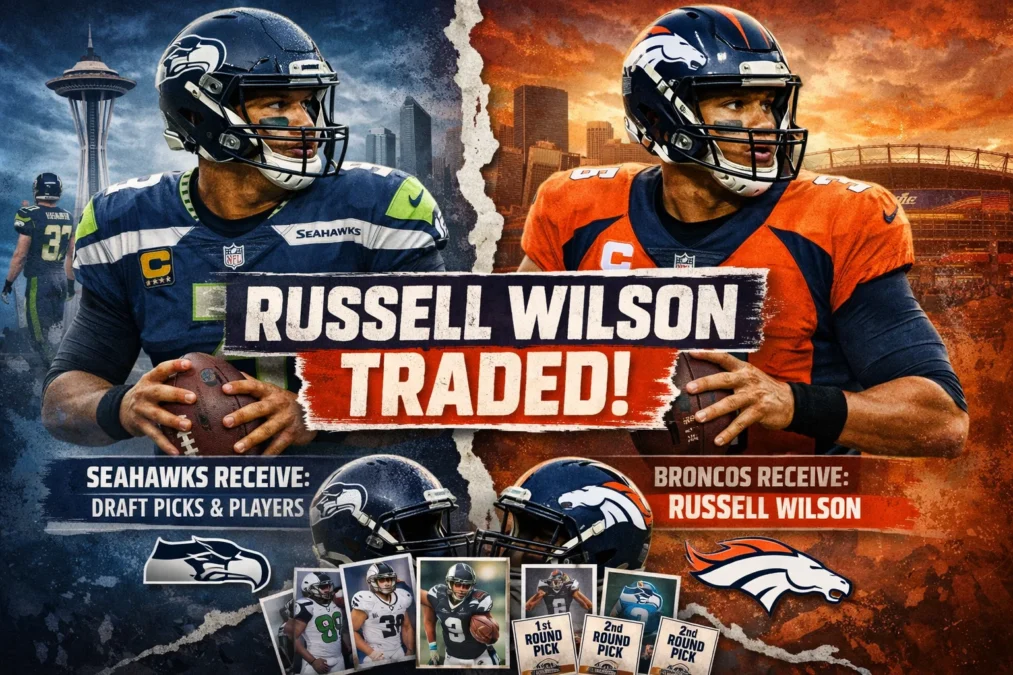
The deal itself was massive by any standard. In March 2022, the Broncos sent a king’s ransom to the Seahawks: two first-round picks, two second-round picks, a fifth-round pick, along with three players—quarterback Drew Lock, defensive tackle Shelby Harris, and tight end Noah Fant. In return, Denver received Russell Wilson and a fourth-round pick. On paper, it looked like a classic win-now move by a franchise desperate to escape the quarterback carousel that had seen names like Trevor Siemian, Case Keenum, Joe Flacco, and Teddy Bridgewater come and go since Manning’s retirement.
At the time, the reaction was overwhelmingly positive for Denver. Seahawks fans were gutted to see their franchise icon depart, while Broncos fans felt they had finally found their savior. What they didn’t know was that behind the scenes, the financial demands were about to make this trade even more complicated. Wilson and his agent, Mark Rodgers, had originally approached the Broncos with an audacious request: a seven-year, fully guaranteed contract worth roughly $350 million—about $50 million per season. According to testimony from a subsequent NFL arbitration hearing, the Broncos “didn’t blink” at the request initially and seemed ready to accept the terms. The quarterback was aiming to reset the market in a way that would have kept him under contract in Denver until he was 42 years old.
Then, something shifted. Within about ten days of the trade being finalized, the Broncos started getting “cold feet,” as Wilson later testified. The NFL Management Council, backed by Commissioner Roger Goodell, reportedly encouraged teams to reduce guarantees in veteran contracts around the same time, a move that the NFL Players Association later challenged as collusion. Ultimately, Wilson signed a five-year, $245 million extension in September 2022, with $161 million guaranteed. It was still a massive payday, but it was a far cry from the fully guaranteed megadeal he had initially sought. That financial commitment would come back to haunt the Broncos in ways no one could have predicted.
The Broncos’ Side: A Season of Disappointment
If you were to script the worst possible start to a new era, the Broncos’ 2022 season would be a strong contender. The excitement that had swept through Denver evaporated almost immediately. The team finished with a disastrous 4-11 record in Wilson’s starts, and the quarterback posted career-worst numbers across the board. His completion percentage plummeted to 59.5%, he threw just seven touchdown passes against five interceptions in his first nine starts, and he was on pace for a career-high 57 sacks. The offense that was supposed to be explosive averaged a paltry 14.7 points per game—a number so low it would have been considered unacceptable in the pre-Manning dark ages.
The dysfunction was visible on every level. Head coach Nathaniel Hackett, hired to be the offensive guru who would unlock Wilson’s potential, seemed completely overwhelmed. He stubbornly refused to give up play-calling duties for weeks before finally relenting and turning them over to quarterbacks coach Klint Kubiak. The move paid immediate dividends when Wilson led a 92-yard opening touchdown drive—only for the offense to stall on nine of the next ten possessions. The problems ran deeper than play-calling, though. Hackett had reportedly scrapped 7-on-7 drills during training camp, a decision that robbed Wilson of hundreds of reps to build chemistry with his receivers. When the games started, those missed connections became glaring.
Perhaps most painful for Broncos fans was the team’s inability to win close games. Denver lost six games by one score, and Wilson made critical mistakes in crunch time that directly cost his team victories. In a particularly agonizing overtime loss to the Las Vegas Raiders, Wilson threw incomplete on third-and-10 rather than sliding to take a sack that would have burned another 40 seconds off the clock, giving the Raiders just enough time to force overtime and eventually win. After the game, Wilson offered a telling reflection: “It’s never good to lose, but it’s almost like, man, at least somebody kick our butt”. The sentiment revealed a team that was losing close games in excruciating fashion rather than simply being outclassed.
The 2023 season under new coach Sean Payton brought some stability, but Wilson’s performance remained inconsistent. He showed flashes of his old self at times, but Payton ultimately benched him for the final two games of the season, a decision that signaled the end of the road in Denver. The Broncos had seen enough. In March 2024, they released Wilson, taking on an NFL-record $85 million in dead cap charges. The Russell Wilson trade had officially become a financial and football catastrophe of historic proportions.
The Seahawks’ Side: Building a Contender
While the Broncos were drowning in disappointment, the Seahawks were quietly assembling the foundation of a future champion. General Manager John Schneider had pulled off one of the most impressive roster rebuilds in recent memory, and the centerpiece of that rebuild was the treasure trove of picks acquired in the Russell Wilson trade.
With the draft capital from Denver, Seattle selected a core group of players who would become the backbone of their eventual Super Bowl run. The haul included left tackle Charles Cross with the ninth overall pick in 2022, edge rusher Boye Mafe with the 40th pick that same year, and then in 2023, they added cornerback Devon Witherspoon with the fifth overall pick and edge rusher Derick Hall with the 37th pick. Cross solidified an offensive line that had been a weakness throughout Wilson’s tenure in Seattle, ranking among the top tackles in pass block win rate. Witherspoon developed into an All-Pro-caliber cornerback, a versatile defender who could cover, blitz, and make game-changing plays. Mafe and Hall combined for 14 sacks and 32 quarterback knockdowns in a single season, forming one of the most formidable edge-rushing duos in the league.
When you add up all the pieces acquired in the Russell Wilson trade, the total is staggering: nine players ultimately came to Seattle as part of the deal, either directly or through the picks that were flipped. Meanwhile, the Broncos ended up with just two players from the transaction—Wilson and defensive lineman Eyioma Uwazurike. The disparity in value is almost hard to comprehend. ESPN’s Bill Barnwell summed it up succinctly, declaring the trade a “massive win for the Seahawks”. He noted that while Seattle’s decision to move on from Wilson without having an immediate quarterback replacement initially seemed risky, the sheer volume of young, cost-controlled talent they acquired made the deal a franchise-altering success.
But the impact of the Russell Wilson trade went beyond just the players selected with Denver’s picks. The move signaled a philosophical shift in Seattle. Schneider and then-coach Pete Carroll recognized that Wilson’s prime years were behind him and that the financial commitment required to keep him would hamstring the rest of the roster. By moving him when they did, they avoided the kind of cap hell that would later engulf Denver. They created flexibility, accumulated assets, and positioned themselves to build a sustainable winner. And in 2026, that vision paid off in the most dramatic way possible: the Seahawks won Super Bowl LX, their second Lombardi Trophy in franchise history.
The Fallout: Wilson’s Post-Denver Journey
After being released by the Broncos, Wilson embarked on a nomadic tour of the NFL that has done little to rehabilitate his reputation. He signed a one-year, $10.5 million contract with the Pittsburgh Steelers for the 2024 season, hoping to prove he still had something left in the tank. His time in Pittsburgh was a mixed bag. The Steelers rotated him with Justin Fields, and while Wilson had moments of competence, the inconsistency that plagued his Denver tenure followed him to Pennsylvania.
In 2025, Wilson landed with the New York Giants, signing another one-year deal with the hope of securing a starting job. That hope lasted exactly three games. After a 0-3 start in which Wilson completed just 59.1% of his passes and threw three touchdowns against three interceptions, the Giants benched him in favor of rookie quarterback Jaxson Dart. It was a stunning fall for a player who had once been considered one of the elite quarterbacks in the league. Wilson, to his credit, handled the demotion with professionalism. He told reporters he was focused on helping Dart transition and had no plans to ask for a trade or release. “I’m focused on helping this team win,” he said. “I want to be here. I love this organization”.
But behind the scenes, the reality was grim. Wilson was released by the Giants when his contract expired in March 2026, and as of this writing, he remains without a team. According to reports, Wilson is struggling “to grasp how far he has fallen from his peak years,” and multiple NFL executives did not even consider him as an option when making quarterback moves. One anonymous executive put it bluntly: “He’s kind of like the forgotten man, right? We weren’t going to do anything with him. He’s a weird fit now. It’s over [for] him as a starter, and I don’t think he sees himself for who he really is”.
The issue, according to insiders, is not just Wilson’s declining physical skills. There is also “great skepticism about his ability to fully grasp being a mentor-type backup,” which has left him without a market. Teams are looking for veteran quarterbacks who can accept a reduced role and help develop younger players. Wilson, who has been a starter for almost his entire career, has struggled to project that kind of humility. Even the Kansas City Chiefs, who were tenuously linked to Wilson as a potential backup, ultimately traded for Justin Fields instead, closing the door on what might have been his last realistic opportunity.
The Financial Aftermath: Contracts, Dead Money, and Cap Hell
No discussion of the Russell Wilson trade would be complete without examining the staggering financial implications. When the Broncos released Wilson in March 2024, they were left with $85 million in dead cap charges—an NFL record. To put that number in perspective, it’s more than some teams’ entire salary cap in the early 2010s. It’s a sum that hamstrung Denver’s ability to build around their next quarterback, forced them to make difficult cuts elsewhere on the roster, and will be cited for years as the ultimate example of a contract gone wrong.
And yet, it could have been so much worse. Remember that original demand for a seven-year, fully guaranteed $350 million deal? If the Broncos had agreed to those terms, they would have been on the hook for Wilson’s massive salary until he was 42, with no escape hatch. The fact that they managed to negotiate down to a five-year deal with $161 million guaranteed—and then found a way to cut ties after just two years—is perhaps the only silver lining in this entire saga. Still, Wilson walked away with $122.79 million from the Broncos despite never playing under the new contract. That’s a staggering sum for two seasons of below-average quarterback play.
From a broader perspective, the Russell Wilson trade and subsequent contract have become a case study in the dangers of paying quarterbacks based on past performance rather than future projection. The Broncos bet that Wilson would maintain his elite level of play into his late thirties, ignoring the signs of decline that had appeared in his final season in Seattle. They paid him like a top-five quarterback, and he performed like a bottom-five starter. It was a mistake that set the franchise back years and forced a complete organizational reset.
How the Broncos Bounced Back
Given the devastation caused by the Russell Wilson trade, it’s remarkable that the Broncos have already begun to emerge from the wreckage. The franchise hired Sean Payton in 2023, a move that brought credibility and structure to a locker room that had been fractured by the Wilson experience. Payton’s first move was to cut bait with Wilson and take the massive dead cap hit, a decision that showed a willingness to endure short-term pain for long-term gain.
The 2025 season saw the Broncos return to the playoffs for the first time since the Super Bowl 50 victory, largely behind the arm of rookie quarterback Bo Nix. Nix had an outstanding first season, bringing stability and playmaking ability to a position that had been a revolving door since Manning’s retirement. The defense, which had been wasted during the Wilson years by an anemic offense, finally got the support it needed. The Broncos are not yet back to Super Bowl contention, but they have a young quarterback, a visionary coach, and—crucially—they are finally done paying Wilson’s contract. That financial flexibility will allow them to add key pieces in free agency and continue their climb back to relevance.
It’s worth noting that not every trade the Broncos made during this period was a disaster. In a move that has been overshadowed by the Wilson debacle, Denver sent pass rusher Bradley Chubb to the Miami Dolphins in exchange for a first-round pick, a fourth-round pick, and running back Chase Edmonds. That first-round pick was later used to acquire Sean Payton from the New Orleans Saints, a move that ESPN’s Bill Barnwell called an “easy win for the Broncos”. So while the Russell Wilson trade will forever be a black mark on George Paton’s record, the general manager at least had the foresight to make one savvy move that helped the team recover.
The Trade’s Legacy in NFL History
Where does the Russell Wilson trade rank among the most lopsided deals in NFL history? Early comparisons were made to the Herschel Walker trade, a 1989 blockbuster that sent the star running back from the Dallas Cowboys to the Minnesota Vikings for a haul of players and picks that became the foundation of the Cowboys’ 1990s dynasty. In that deal, the Cowboys received multiple Pro Bowlers and Super Bowl contributors. In the Wilson trade, the Seahawks received a package that helped them build a championship roster.
The parallels are striking. In both cases, a team traded away a star player at the peak of his perceived value to a desperate suitor, then used the resulting assets to build a sustainable winner. The Cowboys won three Super Bowls in the four years following the Walker trade; the Seahawks won their second championship in franchise history largely on the backs of players acquired from Denver. FOX Sports aptly noted that while the Wilson trade might not be quite as “cockeyed” as the Walker deal, it “sure looks as one-sided as any deal since the Walker washout”. They even gave it a nickname: “The Big Bamboozle”.
But the Russell Wilson trade is distinct in one key way: the contract. Walker was traded before the salary cap era, so the financial consequences were limited to the players and picks exchanged. In the modern NFL, the cap implications of a failed quarterback trade can cripple a franchise for years. The Broncos didn’t just lose draft picks; they lost cap flexibility, roster depth, and the ability to build around the next quarterback. It’s a cautionary tale that general managers will study for decades, a reminder that trading for a veteran quarterback is only half the battle—you also have to be sure he’s still the player you think he is.
Lessons Learned from a Defining Trade
If there’s one overarching lesson from the Russell Wilson trade, it’s that NFL front offices must be brutally honest about player trajectories. The Seahawks saw the signs of decline in Wilson’s final season in Seattle. His mobility was waning, his tendency to hold the ball led to sacks, and his deep-ball accuracy—once his superpower—had become less reliable. They made the difficult decision to move on when his value was still high, and they were proven right.
The Broncos, by contrast, saw only the name, the resume, and the nine Pro Bowl selections. They ignored the warning signs. They doubled down with a massive contract extension before Wilson had even taken a snap in a Broncos uniform. They hired a rookie head coach in Nathaniel Hackett, who was not prepared to manage a veteran quarterback with a strong personality. It was a perfect storm of organizational failure, and it led to one of the most lopsided trades in NFL history.
For teams today, the lesson is clear: evaluate the player, not just the resume. Trust your scouting over market hype. And never, ever fall in love with a quarterback’s past accomplishments to the point where you ignore what he looks like in the present.
Where Are They Now?
As of early 2026, the key figures from the Russell Wilson trade have scattered across the NFL landscape. Russell Wilson is a free agent, struggling to find a team willing to take a chance on him, with reports suggesting he may have played his last down in the league. The Broncos have moved on with Bo Nix and are building toward a brighter future, though the scars of the Wilson era remain. The Seahawks, meanwhile, are Super Bowl champions, with Devon Witherspoon and Derick Hall starring in the title game and the franchise firmly established as one of the NFL’s model organizations.
The players who were part of the trade have followed various paths. Drew Lock, who was the centerpiece of Seattle’s return at quarterback, has bounced around the league as a backup. Shelby Harris and Noah Fant are no longer with the Seahawks, but the draft picks that came from those deals—Cross, Mafe, Witherspoon, Hall—remain cornerstones of Seattle’s roster. It’s a trade that will be analyzed for years to come, a defining moment in the careers of Russell Wilson, John Schneider, George Paton, and countless others.
Conclusion
The Russell Wilson trade will be remembered as one of the most consequential transactions in NFL history—not because it was close, but because it was so decisively one-sided. It transformed two franchises in opposite directions, vaulting the Seahawks back to championship contention while sending the Broncos into a spiral of dysfunction and disappointment. It showed us the best and worst of front office decision-making, the importance of timing in roster building, and the unforgiving nature of the salary cap era.
For Russell Wilson, the trade marked the beginning of a decline that has been painful to watch for anyone who remembers the magic of his early years in Seattle. For the Seahawks, it was the beginning of a rebuild that ended with a Lombardi Trophy. And for the Broncos, it was a lesson in humility, a reminder that there are no shortcuts to sustained success in the NFL. As the years pass, the Russell Wilson trade will be held up alongside the Herschel Walker deal as the gold standard for how a single transaction can alter the trajectory of multiple franchises. It’s a story of ambition, miscalculation, and the harsh reality that in the NFL, the future is never as certain as it seems.
Frequently Asked Questions
What did the Seahawks get in the Russell Wilson trade from the Broncos?
The Seahawks received a massive haul in the Russell Wilson trade, including two first-round picks, two second-round picks, a fifth-round pick, quarterback Drew Lock, defensive tackle Shelby Harris, and tight end Noah Fant. Using those draft picks, Seattle selected foundational players like left tackle Charles Cross, edge rushers Boye Mafe and Derick Hall, and All-Pro cornerback Devon Witherspoon—all of whom contributed to the Seahawks’ Super Bowl LX victory.
Why did the Russell Wilson trade fail so badly for the Broncos?
The Russell Wilson trade failed for the Broncos due to a combination of factors. Wilson’s play declined dramatically from his Seattle days, with career-worst completion percentages and touchdown numbers. The team hired rookie head coach Nathaniel Hackett, who was unprepared for the role and mismanaged the offense. Denver also signed Wilson to a massive contract extension before he played a snap, creating financial pressure that made the eventual release even more painful. The result was a 4-11 record in Wilson’s starts and an NFL-record $85 million dead cap hit upon his release.
Is the Russell Wilson trade the worst in NFL history?
Many analysts compare the Russell Wilson trade to the Herschel Walker trade as one of the most lopsided deals in league history. While the Broncos received two years of below-average quarterback play and an $85 million dead cap charge, the Seahawks used the acquired assets to build a Super Bowl championship roster. The combination of lost draft capital, financial devastation, and franchise-altering consequences puts the Wilson trade in the conversation for the worst trade in NFL history.
What happened to Russell Wilson after leaving the Broncos?
After being released by the Broncos, Russell Wilson signed with the Pittsburgh Steelers for the 2024 season, where he split time with Justin Fields. In 2025, he joined the New York Giants on a one-year deal but was benched after three games in favor of rookie Jaxson Dart. He was released by the Giants in March 2026 and remains a free agent. Reports indicate Wilson is struggling to find a new team, with NFL executives expressing skepticism about his ability to accept a backup role.
How have the Broncos recovered from the Russell Wilson trade?
The Broncos began their recovery by hiring head coach Sean Payton in 2023, who brought stability and credibility to the organization. They drafted quarterback Bo Nix, who had an outstanding rookie season and led the team to the playoffs for the first time in a decade. The franchise also finally finished paying Wilson’s contract, freeing up salary cap space to build around their young quarterback. While the scars of the Russell Wilson trade remain, the Broncos have successfully turned the page.
What role did the draft picks from the Wilson trade play in Seattle’s Super Bowl win?
The draft picks acquired in the Russell Wilson trade were instrumental in Seattle’s Super Bowl LX victory. Charles Cross solidified the offensive line, Devon Witherspoon emerged as an All-Pro cornerback who forced a key pick-six in the Super Bowl, and Derick Hall recorded two sacks in the championship game, including a strip-sack of the Patriots’ quarterback. Boye Mafe also contributed as a key rotational edge rusher. Without those picks, Seattle’s championship roster would not have been possible.