The Neuro Ophthalmologist: The Vision Detective at the Crossroads of Brain and Eye
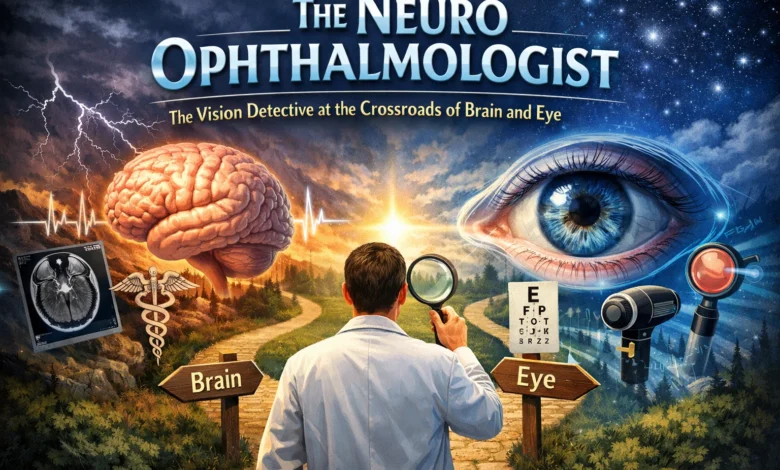
HNeuro Ophthalmologist: ave you ever experienced a moment where something feels profoundly “off” with your vision, yet your regular eye doctor tells you that your eyes themselves look perfectly healthy? It’s a disorienting experience. You know you’re seeing double, or perhaps a shadow has crept into your peripheral vision, but the standard tests come back clear. In these moments of medical mystery, where the eye seems to be a silent witness to a deeper problem, a unique specialist steps into the spotlight: the neuro ophthalmologist.


This physician isn’t just an eye doctor; they are a highly specialized detective who operates at the fascinating and complex crossroads of ophthalmology (the study of the eye) and neurology (the study of the brain and nervous system). To understand their role, imagine the eye as a high-definition camera. A standard ophthalmologist is an expert in the camera itself—the lens, the aperture, the body. But the neuro ophthalmologist is the expert who understands the cable connecting that camera to the supercomputer (the brain) and the software that interprets the footage. They are called upon when the “camera” works fine, but the “footage” is glitching. They diagnose and manage conditions that affect vision because of issues within the nervous system, including the optic nerve, the visual pathways, and the brain centers controlling eye movement. If you’re dealing with unexplained vision loss, mysterious double vision, or eyelid drooping that defies explanation, you are likely on a path that leads to this specialized field.
The Unique Role of a Neuro Ophthalmologist
So, what exactly sets a neuro ophthalmologist apart from your friendly neighborhood optometrist or a general ophthalmologist? It’s all about the scope of their expertise. While an ophthalmologist is a medical doctor trained to manage everything from cataracts to glaucoma, and an optometrist is your primary care provider for vision tests and glasses, the neuro ophthalmologist is a subspecialist. They have completed their standard ophthalmology or neurology residency and then pursued an additional one to two years of fellowship training focused exclusively on the intricate relationship between the eye and the brain.
These specialists are often the “doctor’s doctor,” the final stop for patients whose conditions have stumped other physicians. They are uniquely equipped to evaluate patients not just from an ophthalmologic standpoint, but from a neurologic and even a systemic medical standpoint. This allows them to connect dots that others might miss. For instance, a patient might complain of intermittent double vision. A standard eye exam might show perfect eye health. However, a neuro ophthalmologist might recognize that this double vision, when combined with subtle muscle weakness, is actually the first sign of myasthenia gravis, a chronic autoimmune neuromuscular disease. They don’t just treat the symptom; they find the root cause hidden deep within the nervous system.
When to See a Neuro Ophthalmologist
Knowing when to seek this level of specialized care can be life-changing. Generally, you might be referred to a neuro ophthalmologist if you experience unexplained vision loss that an optometrist or general ophthalmologist cannot attribute to a primary eye disease like cataracts or macular degeneration. Other key red flags include the sudden onset of double vision (diplopia), drooping eyelids (ptosis), or seeing flashes of light (photopsia) that aren’t related to a simple migraine. Pupils that are unequal in size (anisocoria) or unusual eye movements like a constant, involuntary shaking of the eyes (nystagmus) are also classic reasons for referral. If you are experiencing severe, persistent headaches accompanied by vision changes, or if you have been diagnosed with a condition like multiple sclerosis or a brain tumor and need your vision monitored, this subspecialist becomes a critical member of your healthcare team.
Decoding the Visual Pathway: How We See
To truly appreciate the work of a neuro ophthalmologist, one must understand the incredible journey that a visual signal takes. It’s a journey that begins with light hitting your retina and ends with perception in your brain. This pathway is the foundation upon which the entire specialty is built.
The Anatomy of Sight: From Retina to Visual Cortex
The process of seeing is far more complex than simply opening your eyes. Light first enters the eye and strikes the retina, a thin layer of tissue at the back of the eyeball. The retina contains photoreceptor cells—the rods and cones—that convert light into electrical signals. These signals are then gathered and transmitted by the retinal ganglion cells, whose axons bundle together to form the optic nerve.
The optic nerve, a cable of over one million nerve fibers, carries these signals from the eye to the brain. The two optic nerves meet at a crucial junction called the optic chiasm, located at the base of the brain just in front of the pituitary gland. At this point, nerve fibers from the nasal (inner) half of each retina cross over to the opposite side of the brain. This clever arrangement ensures that both hemispheres of the brain receive input from both eyes. From the chiasm, the signals travel along the optic tracts to the lateral geniculate nucleus (a relay station in the thalamus), and finally, to the primary visual cortex at the back of the brain, where the raw data is processed into the images we perceive.
Why the Brain Needs an Eye Doctor
Because this pathway is purely neurological tissue, it is susceptible to the same kinds of diseases that affect the brain. A stroke, a tumor, or inflammation can damage the optic nerve just as easily as it can damage the brain tissue itself. This is precisely why a neuro ophthalmologist is needed. They understand that a defect in your peripheral vision isn’t necessarily a problem with the retina, but could be a tumor pressing on the optic chiasm. They recognize that sudden, painless vision loss in one eye in an elderly patient isn’t just about the eye, but could be a “stroke of the optic nerve,” known as arteritic ischemic optic neuropathy, caused by inflammation of the arteries. They are the bridge between the eye as a sensory organ and the brain as the interpreter, ensuring that no stone is left unturned in the quest to preserve sight.
Common Conditions Treated by a Neuro Ophthalmologist
The scope of conditions managed by a neuro ophthalmologist is vast and varied, ranging from the relatively common to the exceedingly rare. They see patients whose symptoms can be alarming and whose diagnostic journeys are often long. Let’s explore some of the most frequent conditions they encounter.
Optic Nerve Disorders: The Body’s Fiber Optic Cable
The optic nerve is a frequent focus of this specialty. When it malfunctions, the results can be devastating.
Optic Neuritis is one of the most well-known conditions in this category. It involves inflammation of the optic nerve, often causing sudden vision loss and pain, particularly with eye movement. It is frequently associated with demyelinating diseases like multiple sclerosis (MS), where the body’s immune system attacks the protective covering of nerves. For many patients, an episode of optic neuritis is the first clue that they have MS. The neuro ophthalmologist not only treats the acute inflammation, often with steroids, but also coordinates care with neurologists to manage the underlying systemic disease.
Ischemic Optic Neuropathy is another critical condition, essentially a “stroke” of the optic nerve. It occurs when blood flow to the optic nerve is disrupted. There are two main types: arteritic (caused by inflammation of the arteries, such as in Giant Cell Arteritis) and non-arteritic (often linked to high blood pressure, diabetes, or sleep apnea). This is a true emergency, especially the arteritic form, as prompt treatment with high-dose steroids can prevent total blindness in the other eye.
The Puzzle of Double Vision (Diplopia)
Imagine walking down a staircase and seeing two of every step. This is the reality for patients with double vision. When a patient sees double with both eyes open, it means the eyes are not aligned properly. This misalignment is almost always neurological. It can be caused by cranial nerve palsies—damage to the tiny nerves (cranial nerves III, IV, or VI) that control the eye muscles. These nerves can be compressed by an aneurysm, damaged by poor blood supply in diabetes, or inflamed by an infection. A neuro ophthalmologist is skilled at performing a detailed examination to determine which nerve is involved and, crucially, whether the cause is benign or life-threatening, ordering brain imaging to rule out a tumor or aneurysm.
Unexplained Vision Loss and Visual Field Defects
Perhaps the most challenging cases involve patients whose vision is failing, yet their eyes appear normal. These points lead to a problem in the brain. Visual field defects often have very specific patterns that act as a map for diagnosis. For example, bitemporal hemianopia (loss of vision in the outer halves of both visual fields) is a classic sign of a tumor pressing on the optic chiasm, such as a pituitary tumor. A patient might not even notice this loss at first, but a simple visual field test in a neuro-ophthalmologist’s office can reveal the classic pattern, leading to the discovery and treatment of the underlying brain lesion.
Eye Movement Disorders and Nystagmus
The brain has an incredibly complex system for keeping our eyes still and steady so we can see the world clearly. When this system breaks down, the eyes may develop involuntary, rhythmic movements, a condition known as nystagmus. This can make the world appear to constantly shake, a sensation called oscillopsia. Nystagmus can be present from childhood or acquired later in life due to conditions affecting the inner ear, the brainstem, or the cerebellum. A neuro ophthalmologist works to identify the cause of the nystagmus and, while a cure isn’t always possible, can offer treatments like prisms, medications, or sometimes surgery to help manage the symptoms and improve quality of life.
“Neuro-ophthalmology is the best field in medicine. You get to be a detective every single day. You use your brain to save someone’s sight, and in many cases, you are using the eyes to save the brain.” — A sentiment shared by many practitioners in the field.
The Diagnostic Toolkit: More Than Just an Eye Chart
When you visit a neuro ophthalmologist, prepare for an exam that is far more comprehensive than any you’ve had before. Their diagnostic toolkit is a blend of classic eye exams and advanced neurological imaging, all aimed at tracing the source of the problem.
The Comprehensive Neuro-Ophthalmic Examination
This is the cornerstone of every visit. It begins with a detailed history, but the physical exam is where the detective work truly shines. In addition to checking your visual acuity, the neuro ophthalmologist will meticulously examine your pupil responses, looking for subtle differences in how they react to light, which can indicate optic nerve damage. They will assess your color vision, as it is often disproportionately affected in optic nerve disorders. They will have you follow a target in various directions of gaze to check for weakness or restriction in your eye muscles. They will also perform a visual field test, either by using a computerized machine or simply by facing you and using their own fingers to map the boundaries of your peripheral vision.
Advanced Imaging: MRI, OCT, and Beyond
The physical exam often provides the “where,” but imaging provides the “what” and “why.” A neuro ophthalmologist relies heavily on MRI (Magnetic Resonance Imaging) of the brain and orbits. This technology allows them to visualize the entire visual pathway, from the optic nerves to the visual cortex, looking for tumors, inflammation (like the plaques of multiple sclerosis), or signs of increased pressure in the brain.
Another indispensable tool in their arsenal is OCT (Optical Coherence Tomography). This non-invasive imaging test is like an ultrasound for the eye, providing incredibly detailed, cross-sectional images of the retina and the optic nerve head. It can measure the thickness of the nerve fiber layer, allowing the doctor to objectively track nerve damage or swelling over time. As optometrist Jaci Theis notes, looking at the ganglion cell layer with OCT is often “much more sensitive to earlier changes” than looking at the nerve fiber layer alone, allowing for even earlier detection of neurodegenerative processes.
The “Rule of 3” for Emergencies
In the fast-paced world of neuro-ophthalmic diagnosis, experts have developed simple heuristics to quickly identify emergencies. One such pearl is the “rule of 3.” If a patient presents with an isolated problem—say, just a pupil issue, just an eyelid droop, or just an eye movement problem—the likelihood of a true emergency is lower. However, as Dr. Jaci Theis explains, “if you have 2 of the 3… then the likelihood that someone has a neuro-ophthalmologic emergency is much higher”. For example, a patient with a dilated pupil (pupil issue) and a droopy eyelid (eyelid issue) is a classic presentation for a third nerve palsy, which could be caused by a life-threatening aneurysm. This simple framework helps ensure that the sickest patients get immediate attention and imaging.
The Neuro Ophthalmologist as Part of a Care Team
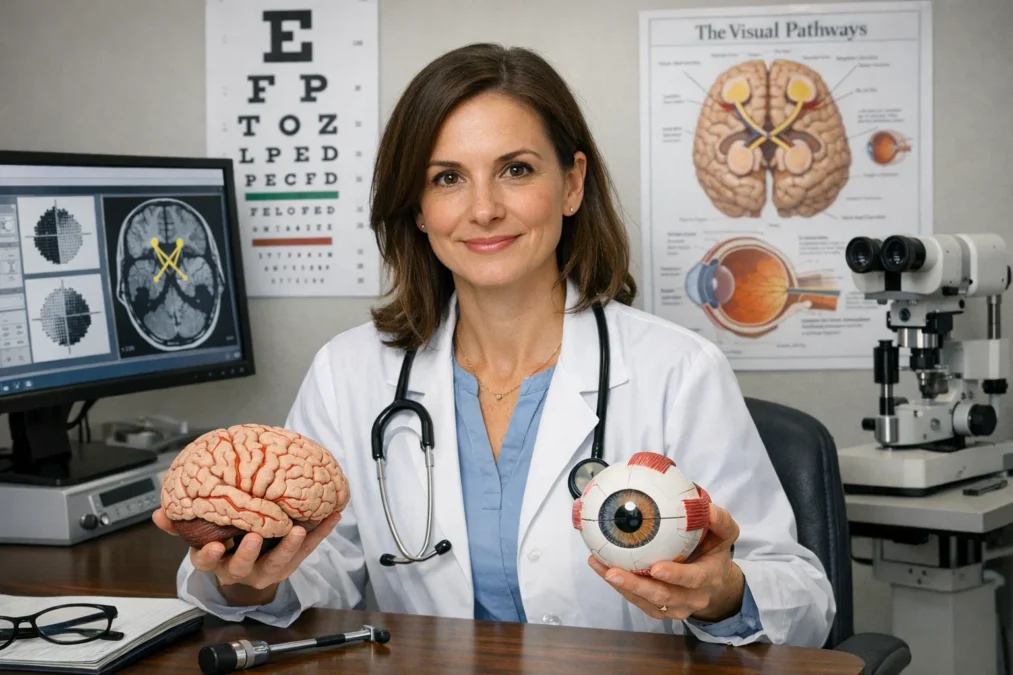
A neuro ophthalmologist rarely works in a silo. Their role is often that of a central hub, connecting various medical specialties to ensure a patient receives holistic care.
Collaboration with Neurosurgeons and Neurologists
The relationship with neurology is perhaps the most intrinsic. For a patient newly diagnosed with multiple sclerosis after an episode of optic neuritis, the neuro ophthalmologist will manage the eye-specific symptoms and monitor for future optic nerve issues, while the neurologist will manage the overall disease course with disease-modifying therapies. Similarly, collaboration with a neurosurgeon is vital. If a patient is found to have a pituitary tumor compressing the optic chiasm, the neuro ophthalmologist performs the crucial pre- and post-operative visual field testing to guide the surgeon and measure the success of the surgery.
Vision Rehabilitation and Prism Therapy
Beyond diagnosing and treating disease, a core part of the neuro ophthalmologist’s mission is helping patients adapt and live fuller lives with permanent vision deficits. For stroke patients who have lost half their visual field (homonymous hemianopia), simply navigating a room can be dangerous. This is where innovative techniques like prism adaptation therapy come in. By fitting a patient with special glasses that have prisms ground into the lenses, the neuro ophthalmologist can optically “shift” the image from the blind field into the seeing field. It doesn’t restore the lost vision, but it helps the patient detect obstacles and people in their blind spot, drastically reducing falls and improving their confidence and independence. This type of practical, life-changing intervention is a hallmark of the specialty.
When to Seek a Neuro Ophthalmologist
So, how do you know if it’s time to ask your doctor for a referral? While the symptoms can be varied, the underlying theme is often “unexplained.” You should absolutely consider seeing a neuro ophthalmologist if you experience a sudden or gradual loss of vision that your regular eye doctor cannot explain by examining your eyes. Persistent double vision is another major sign, especially if it lasts for more than a few days. If you have headaches that are localized around your eye or accompanied by vision disturbances, or if you or your family notice a droopy eyelid that comes and goes, it’s time to dig deeper.
The “Last Stop” for Complex Cases
In many healthcare systems, the neuro ophthalmologist is regarded as the “last stop” for patients who have been on a diagnostic odyssey. They are the experts who see patients when the diagnosis is not obvious. Because their training encompasses both the eye and the brain, they can cast a wider diagnostic net. A general ophthalmologist might treat the dry eye that is causing discomfort, but a neuro-ophthalmologist might recognize that discomfort as a sign of a more pervasive neurological issue. This ability to see the bigger picture is what makes them indispensable. As one source noted, seeing a neuro ophthalmologist can often “avoid costly diagnostic testing” by providing a clear diagnosis more efficiently.
The Future of Neuro-Ophthalmology
The field of neuro-ophthalmology is not static; it is a rapidly evolving specialty on the cutting edge of medical technology.
Shortage and Growing Demand
Despite its critical importance, there is a significant and well-documented shortage of neuroophthalmologists worldwide. In the United States alone, it was estimated years ago that the country needed 25% more of these specialists to meet patient demand. This shortage is even more acute in other countries; for example, Malaysia was reported to have only four practicing neuro-ophthalmologists for its entire population. This scarcity means that patients often face long wait times for appointments. However, it also means that those who enter the field are incredibly valued members of the medical community, playing a crucial role in teaching, research, and complex patient care.
The Eye as a Window to Brain Health
Perhaps the most exciting frontier in this field is the growing recognition of the eye as a direct window into the health of the brain. Because the retina is an extension of the central nervous system, changes in the retina can mirror changes in the brain. Research is increasingly showing that retinal biomarkers detected on OCT scans may reveal the early stages of neurodegenerative diseases like Alzheimer’s disease and Parkinson’s disease years before cognitive symptoms appear. The neuro ophthalmologist of the future may not just be saving your sight; they may be providing the earliest warning signs for diseases that affect your memory and movement, allowing for earlier intervention and better outcomes. The retina holds the potential to become a routine screening tool for brain health, and these specialists will be at the forefront of interpreting that data.
Conclusion
The path to a neuro ophthalmologist is often traveled by those facing the most perplexing and frightening visual symptoms. It is a path that leads to a physician who is part eye expert, part brain expert, and part medical detective. These specialists possess the unique ability to look past the eye itself and see the intricate neural wiring that makes vision possible. They treat the devastating consequences of strokes and tumors, they unravel the mysteries of autoimmune diseases attacking the optic nerve, and they restore function and independence to those living with permanent visual field loss through innovative rehabilitation.
They are the essential link between the eye and the brain, ensuring that when the camera works, but the footage is scrambled, there is someone who understands the wiring. As we move into an era where the eye is increasingly seen as a mirror to our neurological future, the role of the neuro ophthalmologist will only grow in importance. If you or a loved one is facing unexplained vision problems, remember that there is a specialist trained to find the answers where others cannot. They are the vision detectives, and they are watching over the most critical connection you may never have known you had.
Frequently Asked Questions About Neuro Ophthalmologists
Q: What is the main difference between an ophthalmologist and a neuro-ophthalmologist?
A: An ophthalmologist is a medical doctor who specializes in the health and diseases of the eyeball itself, such as cataracts or glaucoma. A neuro ophthalmologist is first an ophthalmologist (or neurologist) who then completes additional fellowship training to specialize in vision problems related to the brain and nervous system. They handle issues where the eye is structurally healthy, but vision is failing due to problems along the optic nerve or visual pathways in the brain.
Q: Do I need a referral to see a neuro ophthalmologist?
A: In most healthcare systems, yes. Because it is a subspecialty, you will typically need a referral from your primary care doctor, optometrist, or general ophthalmologist. They will refer you when they have ruled out common eye conditions and suspect a neurological cause for your symptoms. This process helps ensure that you are seeing the right specialist for your specific problem.
Q: What kind of tests will a neuro ophthalmologist perform?
A: You can expect a very thorough, non-invasive examination. This includes standard vision and eye pressure tests, but also specialized assessments of your color vision, pupils, eye movements, and peripheral vision (visual field test). They will likely use advanced imaging like OCT to scan your optic nerve and may order an MRI of your brain to get a detailed look at the entire visual pathway. The whole process can take a significant amount of time because they are performing two exams in one: a full eye exam and a neurological exam.
Q: Can a neuro ophthalmologist help with my migraines?
A: It depends on the type of migraines. If you have typical migraines with headaches, they are usually managed by a neurologist or primary care doctor. However, if you experience “ocular migraines” or visual auras that are complex or atypical, or if your headaches are accompanied by persistent vision changes or eye pain, a neuro ophthalmologist can be very helpful. They can determine if the visual symptoms are truly from a migraine or if they are caused by another issue affecting the eye or optic nerve.
Q: What is the most common emergency in neuro-ophthalmology?
A: One of the most time-sensitive emergencies is Giant Cell Arteritis (also called Temporal Arteritis). This is an inflammation of the arteries that can quickly block blood flow to the optic nerve, causing sudden, permanent blindness in one or both eyes. A neuro ophthalmologist can recognize the symptoms (which may include vision loss, headache, scalp tenderness, and jaw pain), perform a biopsy to confirm it, and start high-dose steroid treatment immediately to prevent total blindness.
Q: Is double vision always a sign of a brain tumor?
A: No, it is not always a brain tumor, but it is a symptom that must be taken seriously. Double vision (diplopia) can be caused by many things, including microvascular nerve damage (common in people with diabetes or high blood pressure), thyroid eye disease, or myasthenia gravis. However, because it can also be caused by an aneurysm or a tumor compressing a nerve, it is essential to see a neuro ophthalmologist for a comprehensive evaluation to rule out life-threatening causes.
Q: Will my insurance cover a visit to a neuro ophthalmologist?
A: In most cases, yes. Because a neuro ophthalmologist is a medical doctor diagnosing and treating medical conditions, the visit is typically covered by medical insurance (like Medicare or private health insurance) rather than just vision insurance. It is always best to check with both your insurance provider and the doctor’s office beforehand to understand your coverage and any prior authorization requirements.
Summary of Key Neuro-Ophthalmology Conditions and Signs
| Category | Common Conditions | Key Symptoms |
| Optic Nerve | Optic Neuritis, Ischemic Optic Neuropathy | Vision loss, pain with eye movement, color desaturation |
| Eye Movement | Cranial Nerve Palsies, Nystagmus, Myasthenia Gravis | Double vision, drooping eyelids, “shaking” eyes |
| Visual Pathway | Pituitary Tumor, Stroke | Peripheral vision loss (e.g., hemianopia), unexplained vision loss |
| Pupils | Horner’s Syndrome, Third Nerve Palsy | Unequal pupil size, droopy eyelid on the same side |