The Ultimate Guide to Biography Examples: Crafting Inspiring Life Stories That Readers Will Love
Biography Examples: Have you ever found yourself completely lost in the story of someone’s life? Maybe you started reading about a historical figure before bed and suddenly realized it was 2 a.m. That is the unique power of a well-told life story. A great biography does more than just list dates and accomplishments. It transports you into another person’s world, allowing you to experience their struggles, triumphs, and everyday moments as if you were walking in their shoes.

Whether you are a student tasked with a project, a writer planning your next book, or simply someone curious about the lives of fascinating people, studying different biography examples is the best way to understand what makes these stories tick. They show us how to transform a simple list of facts into a compelling narrative that educates, entertains, and inspires. In this guide, we will explore the vast landscape of biographical writing. We will look at famous biography examples from history, dissect short professional bios, and even provide you with the tools to start writing your own. By the end, you will see that every life is a story worth telling, and you will have the roadmap to tell it right.
What Defines a Biography and Its Unique Place in Literature
Before we dive into the specific examples, it is important to understand what we are actually talking about. A biography is much more than a simple summary of a person’s life. It is a detailed, often book-length, account of someone’s existence, written by another person. This distinction is crucial because it separates it from an autobiography, which is written by the subject themselves.
The beauty of a biography lies in its perspective. The author acts as both a detective and an artist. They dig through archives, letters, and interviews to find the raw data of a life, but they also shape that data into a story with a narrative arc. This process allows the biographer to provide context that the subject themselves might not have seen. For instance, while a historical figure might have simply recorded the events of a specific day in their diary, a biographer can look back and explain why that day was a turning point in the context of world events.
Furthermore, biographies occupy a unique space in literature because they satisfy our innate curiosity about other people. We read them to find answers to universal questions. How did someone handle failure? What does it take to achieve greatness? How do ordinary people become extraordinary? By examining the biography examples we will discuss shortly, you will notice that the best ones answer these questions not with dry facts, but with immersive storytelling. They adhere to the truth while using the techniques of fiction—like character development, dialogue, and suspense—to keep the reader turning the page.
Full-Length Biography Examples That Defined the Genre
When most people think of a biography, they imagine a comprehensive book that covers a person’s entire journey from birth to death (or the present day). These full-length works are the heavyweights of the genre, requiring years of research and hundreds of pages to do their subjects justice. They serve as the gold standard for biography examples because they offer a complete picture.
The Comprehensive “Life and Times” Biography
This is the classic model of biographical writing. It places the subject firmly within the context of their historical era, showing how they were shaped by the world around them and how they, in turn, shaped that world. A perfect example of this is Ron Chernow’s Alexander Hamilton. Chernow didn’t just write about Hamilton the man; he wrote about the birth of the American financial system, the brutality of colonial politics, and the messy reality of the Revolutionary War. By weaving the personal and the historical together, Chernow created a biography that feels as epic and urgent as a novel. This book became the inspiration for the hit musical Hamilton, proving that a well-researched, 800-page historical text can massively capture the public’s imagination. This type of biography works well when the subject’s life is deeply intertwined with major historical events.
The Biographical Portrait of a Troubled Genius
Some biographies focus less on the wide-angle lens of history and more on the intense close-up of the human psyche. These biography examples seek to understand the inner workings of a creative or brilliant mind, warts and all. Walter Isaacson’s Steve Jobs is a masterclass in this approach. Isaacson, given unprecedented access to Jobs, presents an unflinchingly honest portrait. He details Jobs’ genius for design and marketing, but he also explores his cruelty, his tantrums, and his obsessive perfectionism.
The book works so well because it doesn’t try to make you like Steve Jobs; it tries to make you understand him. It connects his unconventional upbringing and his embrace of Eastern philosophy to the minimalist aesthetics of Apple products. For anyone looking to write about a complex figure, this biography is a crucial study. It shows that a biographer must be objective. You cannot bury the subject’s failures just because you admire them, nor can you ignore their achievements just because you disagree with their personality. The goal is to present a balanced, three-dimensional human being.
The Narrative Nonfiction Approach
Another powerful style is the narrative nonfiction biography, which reads like a thriller even though every word is true. Laura Hillenbrand’s Unbroken is one of the best-selling biographies of this style. The story of Louis Zamperini—an Olympic runner turned WWII bombardier who survives a plane crash, drifts on a raft for 47 days, and is then tortured in Japanese prisoner-of-war camps—is inherently dramatic. But Hillenbrand’s genius lies in her pacing, her sensory details, and her ability to build suspense even though the reader knows Zamperini survives.
Hillenbrand teaches us that facts don’t have to be boring. She uses the techniques of a novelist to pull the reader into the experience. When you read Unbroken, you feel the sunburn from the raft and the hunger pangs from the prison camp. This style requires immense research to find the small, sensory details that bring a scene to life—the sound of a plane engine, the smell of a prison cell, the texture of a letter from home.
Short and Mini Biography Examples for Quick Impact
Not every life story requires a 500-page book. In our fast-paced digital world, short biography examples are often more practical and just as powerful. These condensed versions require a different skill set: the ability to distill an entire life into its absolute essence. Whether you are writing for a school assignment, a website, or a social media profile, knowing how to write concisely is a valuable skill.
The Biographical Sketch for Students
In academic settings, students are often asked to write biographical sketches based on given points. These exercises teach the fundamentals of biographical writing: selection, organization, and clarity. For example, a typical exercise might provide points about a historical figure like William Shakespeare, asking students to form them into a coherent paragraph.
Consider the points provided for Shakespeare: born April 23, 1564; married Anne Hathaway; wrote 38 plays; died April 23, 1616. A good student will see the poetry in those dates—the symmetry of being born and dying on the same day—and use it as a framing device. The resulting sketch might note that “William Shakespeare, the greatest dramatist of all times, is said to have been born at Stratford-on-Avon on 23rd April 1564, which happens also to be the date of his death in 1616”. This simple observation turns a list of facts into a meaningful statement about the circle of life. These short biography examples teach us that you don’t need a lot of space to create impact. You just need to find the right connection between the facts.
The Mini-Biography for General Readers
Publishers have long recognized the market for concise, accessible biographies. Series like the “Who Was…?” books have become incredibly popular because they offer a “brief peep into the personality’s life, services and wonderful achievements” in a format that is easy and engaging. These mini-biographies typically run around 150 pages and are illustrated, making them perfect for young readers or adults who want a quick overview.
What makes these biography examples so effective is their focus on the human interest angle. A mini-biography of Steve Jobs might focus on the fact that he used to show up barefoot to business meetings or that he collected Coke bottles for money to buy food in college. A story about Neil Armstrong might highlight that he got his pilot’s license before his driver’s license. These details are relatable. They remind us that great people started as curious kids with hobbies and dreams. For writers, the lesson is clear: even in a short format, prioritize the anecdotes. A single, well-chosen story can communicate more about a person’s character than a page of generic praise.
Professional and Short Bio Examples for the Modern World
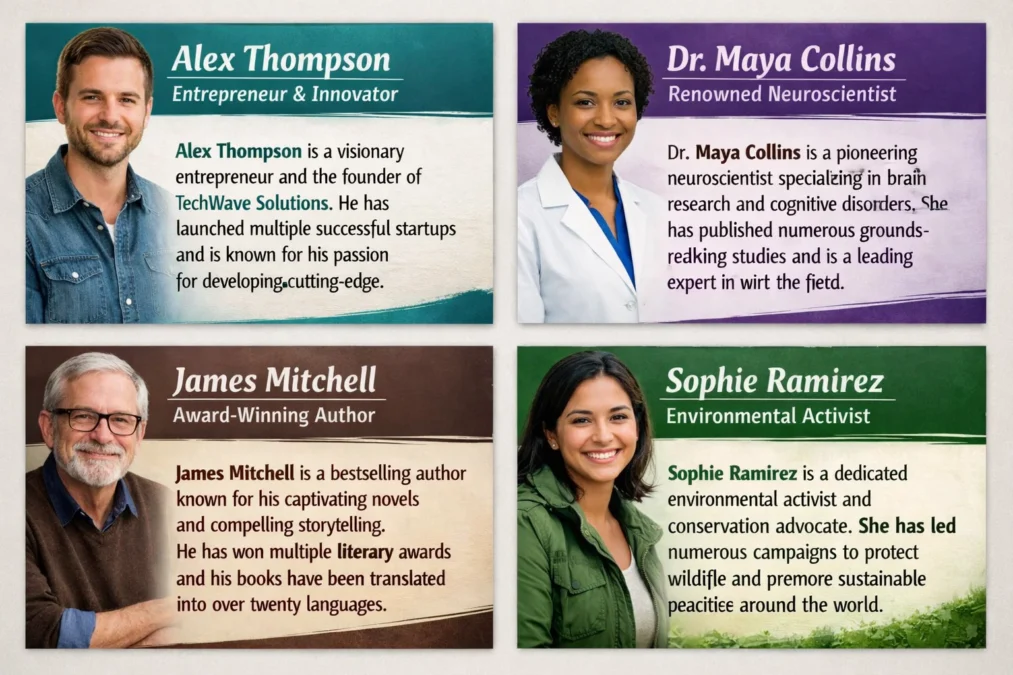
In the professional realm, biography writing takes on a very practical purpose. You aren’t trying to tell the full story of a life; you are trying to establish credibility, build a brand, or introduce yourself to a potential employer or client. These biography examples are often written in the third person and range from a single sentence to a few paragraphs.
The Social Media Micro-Bio
The most constrained form of biography is the one you see on Twitter (X), Instagram, or LinkedIn. You might have a limit of 160 characters, forcing you to be incredibly economical with your words. A good social media bio answers three questions instantly: Who are you? What do you do? Why should I care?
For example, a freelance graphic designer might write: “Award-winning graphic designer helping brands tell their story through bold visuals. 🎨 Lover of minimalism, coffee, and good typography.” This short bio establishes the profession, the value proposition (helping brands), and a touch of personality (the emojis and hobbies). It is a snapshot designed to make people want to click “Follow” or visit your portfolio. These biography examples are all about branding and first impressions.
The Professional “About Me” Page
On a company website or a portfolio, you have more room to breathe. A professional bio of 100 to 300 words should build trust with the reader. It usually follows a structure: start with the present role and key expertise, move to the past to show the journey and experience, and end with the future or a personal touch.
Here is a table breaking down the structure of a strong professional bio:
| Section | Purpose | Example Phrasing |
| The Hook | Introduce who you are and your current role with confidence. | “Maria Gonzalez is a seasoned marketing strategist with over a decade of experience driving growth for Fortune 500 companies.” |
| The Journey | Briefly outline your career path, highlighting key achievements and skills. | “She began her career at a boutique ad agency before moving in-house at TechCorp, where she led a campaign that increased revenue by 40%.” |
| The Values | Connect your work to a broader philosophy or why you do what you do. | “Maria believes that the best marketing tells a human story, and she is passionate about building brands that resonate authentically.” |
| The Personal | Add a humanizing detail to make you relatable. | “When she is not in the office, you can find her hiking the Rockies with her rescue dog, Luna.” |
Biography Examples from Diverse Fields and Cultures
The best way to appreciate the breadth of biographical writing is to look at the variety of lives being documented. From activists to inventors, from artists to scientists, each life offers a different kind of lesson. The Smithsonian’s National Museum of American History provides a treasure trove of such biography examples in its “American Enterprise” exhibit, highlighting how individuals shaped the nation’s economy and culture.
The Activist: Cesar Chavez
The biography of Cesar Chavez is a powerful reminder that one person can challenge massive systems. Co-founder of the United Farm Workers, Chavez never forgot his roots. His biography is often symbolized by his father’s short-handled hoe, a tool that represented the backbreaking and demeaning work of migrant laborers. A biography of Chavez isn’t just about labor laws; it is about dignity. It explores how he organized workers whom many thought were “unorganizable.” By using non-violent tactics like hunger strikes and the powerful call of “Sí, se puede” (Yes, we can), he galvanized a nation. This example shows how a biography can focus on the theme of resilience against oppression.
The Scientist: Norman Borlaug
Not all heroes wear capes; some carry test tubes. Norman Borlaug was a plant scientist whose work arguably saved more lives than any other person in history. His biography details the “Green Revolution,” where he designed and bred new varieties of wheat and rice that produced massively higher yields. Writing a biography about a scientist requires the ability to explain complex ideas—like genetic cross-breeding—in a way that is understandable to the average reader. Borlaug’s story is about the intersection of human ingenuity and human need, a narrative that earned him the Nobel Peace Prize in 1970.
The Artist: Elizabeth Arden
Elizabeth Arden, born Florence Nightingale Graham, built an empire on the power of reinvention. Her biography is a fascinating look at business, beauty, and the changing role of women in the early 20th century. She convinced a generation of women that wearing makeup was socially acceptable, transforming cosmetics from a fringe product into a mainstream necessity. Her story is not just about creams and lipsticks; it is about marketing psychology and the creation of an “aura of exclusivity.” Similarly, her contemporary, Estée Lauder, offers a lesson in salesmanship, having famously said, “I have never worked a day in my life without selling. If I believe in something, I sell it, and I sell it hard”. These biography examples show how personal ambition can reflect and drive broader social changes.
The Anatomy of a Strong Biography: Structure and Style
Writing a biography is a craft. It requires a solid structure to support the narrative, just as a skeleton supports a body. Whether you are writing a 5,000-word essay or a 100,000-word book, understanding this anatomy is crucial. As one educational resource notes, a biography typically has three main parts: an introduction, a body, and a conclusion.
The introduction must do more than just say “This is John Smith.” It needs to hook the reader. This can be achieved by starting with a dramatic moment from the subject’s life—perhaps the day they made a fateful decision or faced a major crisis. The introduction should also subtly hint at the thesis of the book: why this life matters.
The body is usually organized chronologically, telling the story from childhood through to old age. However, strict chronology can sometimes become a trap, leading to the dreaded “and then, and then” problem. To avoid this, effective biographers group events thematically. For instance, a chapter might focus on the subject’s role as a parent, while the next focuses on their professional breakthrough, even if these timelines overlap slightly. The key is to maintain a sense of cause and effect, showing how early experiences shaped later actions.
Finally, the conclusion should do more than just state the date of death. It should reflect on the subject’s legacy. What was their outlook on life? What was their final, memorable act or statement? A strong conclusion ties back to the themes introduced at the beginning, leaving the reader with a sense of closure and a clear understanding of the subject’s place in the world.
How to Write Your Own Biography: A Step-by-Step Approach
Feeling inspired to write a biography yourself? Whether for a school project or a personal passion, the process can be broken down into manageable steps. By following these guidelines, you can turn a pile of research into a compelling narrative.
Step 1: Choose Your Subject and Your “Why”
You must care about the person you are writing about. If you aren’t interested in them, your reader won’t be either. Ask yourself: why is this story worth telling? Did they overcome incredible odds? Did they invent something that changed the world? Defining your “why” will give you a focus for the entire project.
Step 2: Research Like a Detective
Gather information from everywhere. Look for primary sources like letters, diaries, and photographs. Check secondary sources like newspaper articles and existing books. If possible, conduct interviews with people who knew them. A good rule of thumb is to “cross-reference materials” and try to “find a fact in three different sources to make sure it is accurate”.
Step 3: Create a Working Outline
Don’t just list facts in order. Decide on the major themes of the person’s life. A good structure for a school paper might be: Introduction, The Life (Biography), The Times (Historical Context), and Legacy (Commemoration). This helps you organize your thoughts and ensures you don’t just write a timeline, but an analysis.
Step 4: Write with Narrative Flair
Remember that you are telling a story. Use vivid language. Describe the settings. Include dialogue if you have it from your research. Focus on the “puzzles” of their life—the contradictions or the tough choices—to keep the reader engaged. Balance the facts with a compelling narrative drive.
Frequently Asked Questions (FAQ) About Biography Examples
Q1: What is the difference between a biography and an autobiography?
A: The main difference lies in the author. A biography is the story of a person’s life written by someone else. It is usually written in the third person (he/she/they) and is based on research from various sources. An autobiography is written by the subject themselves, using first-person narration (I/me) and reflecting their own personal memories and perspectives.
Q2: Can you provide a simple biography example for a student assignment?
A: Certainly. A simple student biography example might read: “Dr. Rajendra Prasad was born in 1884 in a small village in Bihar. He received his early education locally before moving to Calcutta for higher studies, where he consistently stood first in his examinations. A successful lawyer at the Calcutta High Court, he eventually left his practice to join the freedom movement with Gandhiji. He was a dedicated leader who later became the first President of India, serving his nation with humility and wisdom.
Q3: Where can I find good biography examples to read?
A: There are many excellent sources. For classic long-form biographies, look for Pulitzer Prize winners like The Power Broker by Robert Caro. For shorter, accessible reads, the “Who Was?” book series offers great biography examples for younger readers and adults alike. Your local library is also a goldmine, with sections dedicated to biographies on everyone from scientists like Temple Grandin to artists like Frida Kahlo.
Q4: How do you start a biography?
A: The best way to start a biography is with a hook. Avoid beginning with “So-and-so was born on…” Instead, try a “flashback” or a “vignette” that shows the subject at a pivotal moment. You could open with them making a life-changing decision, winning a major victory, or facing a devastating loss. This draws the reader in and makes them want to know how the person got to that point.
Q5: What are the key elements of a professional short bio?
A: A professional short bio should include your current role and main responsibilities, your key achievements or skills, your professional philosophy or values, and a small personal detail to humanize you. It should be concise, written in the third person, and tailored to your audience, whether that is LinkedIn connections or potential clients.
Q6: How do I ensure my biography is accurate?
A: Accuracy is the cornerstone of good biographical writing. Always verify your facts with multiple sources. If you find conflicting accounts, don’t ignore them. A good biographer will acknowledge the discrepancy and present both sides to the reader, explaining the source of the conflict. When in doubt, rely on primary sources like letters, official documents, and contemporary interviews over secondary interpretations.
Conclusion
The world is full of stories waiting to be told, and studying biography examples is the key that unlocks the door to telling them well. From the sweeping historical narratives of Ron Chernow to the tight, focused prose of a social media bio, the art of capturing a life is a versatile and rewarding skill. We have seen how a scientist like Norman Borlaug can save millions without ever leaving the lab, and how an activist like Cesar Chavez can move a nation with a simple phrase. We have learned that structure matters, that research is sacred, and that the best stories are always true.
As you close this article, think about the lives that have touched yours. Perhaps it is a famous historical figure you have always admired. Perhaps it is a grandparent whose stories of youth have always fascinated you. Maybe it is even your own journey. Writing a biography is an act of preservation. It is how we pass down wisdom, honor achievement, and learn from the past. So, pick up a pen, open a notebook, or start a file on your computer. The world needs to hear the stories you have to tell, and now you have the roadmap to tell them right.