The Ultimate Guide to Writing a Statement of Purpose That Stands Out
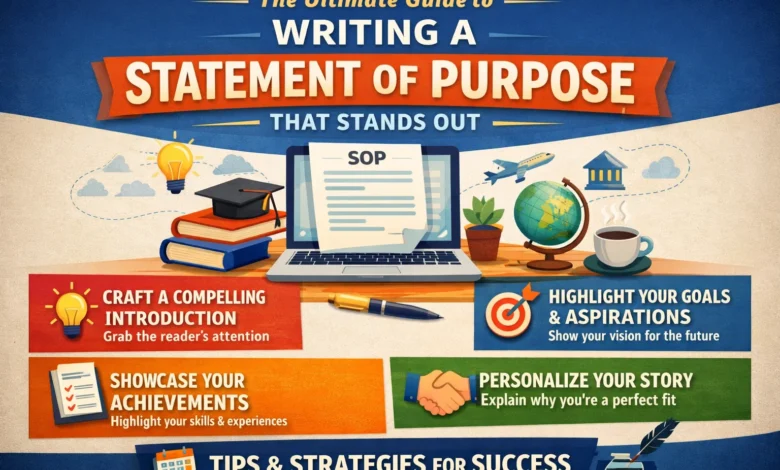
Statement of Purpose: Let’s be honest for a second. Staring at a blank page, knowing that the next 500 to 1,000 words could significantly impact the trajectory of your career, is terrifying. For many prospective graduate students, the statement of purpose is the single most daunting component of the application process. Your GPA is a set number. Your GRE scores are what they are. Your resume lists your jobs and publications in stark, black-and-white bullet points. But the statement of purpose? That is different. It is the only part of your application where the numbers fall away, and you get to have a conversation with the admissions committee.


Think of the statement of purpose as your personal courtroom testimony. The admissions committee has all the evidence (your transcripts, your resume, your letters of recommendation), but your statement is where you get to connect the dots for them. It’s where you explain why the messy, beautiful, winding path of your life has led you directly to their door. A well-crafted statement of purpose doesn’t just rehash your CV; it provides context, demonstrates passion, and proves that you have the intellectual maturity to handle the rigors of advanced study.
In this guide, we will dismantle the mystery surrounding the statement of purpose. We’ll move beyond the clichés and the anxiety, providing you with a blueprint to write a narrative that is uniquely yours. Whether you are applying to a Ph.D. program in mechanical engineering, a Master of Public Health, or an MBA, the principles of storytelling, specificity, and fit remain the same. By the end of this article, you will have the tools to transform your statement of purpose from a chore into a compelling asset.
Decoding the Statement of Purpose: What Are They Really Asking?
Before you type a single word, you must understand the rhetorical situation of the statement of purpose. It is easy to fall into the trap of thinking this is just another essay about “what I want to be when I grow up.” In reality, the admissions committee is using your statement to answer three very specific questions about you.
First, they are asking: “Can you think?” Graduate school is an intense intellectual endeavor. The committee wants to see evidence that you can formulate a coherent argument, that you understand the nuances of your chosen field, and that you have specific research interests. They don’t expect you to have your dissertation mapped out, but they do expect you to demonstrate intellectual curiosity and direction.
Second, they are asking: “Can you write?” This might seem obvious, but it is crucial. Whether you are going into the sciences or the humanities, clear writing is a reflection of clear thinking. A poorly written statement of purpose riddled with jargon, typos, or vague statements suggests a disorganized mind. The committee needs to know that you can communicate complex ideas effectively, as this is a skill you will need to write papers, theses, and grant proposals.
Finally, and perhaps most importantly, they are asking: “Who are you?” With dozens or even hundreds of applicants boasting similar GPAs and similar research assistant positions, the statement of purpose is the tiebreaker. It’s where your personality can shine through. They want to know what makes you tick, what specific moment ignited your passion, and what unique perspective you will bring to their campus. As one expert puts it, your statement is your chance to show the person behind the numbers.
The Core Components: Building the Narrative Arc
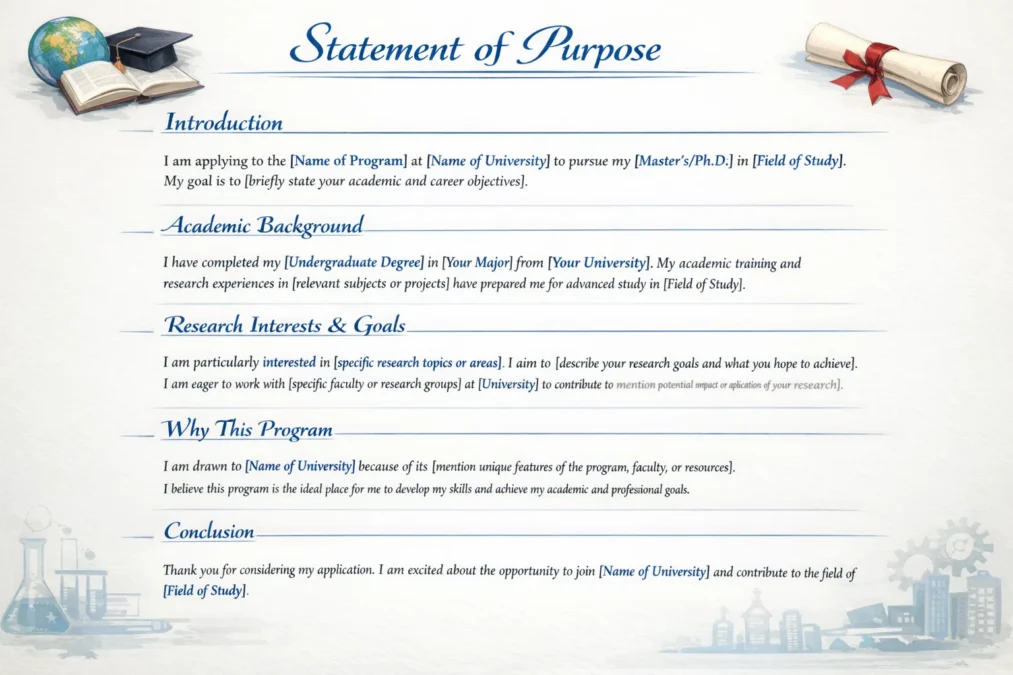
While every statement of purpose should be unique, successful ones generally follow a specific narrative structure. Think of it as a story with a clear beginning, middle, and a forward-looking end. This structure usually revolves around three pillars: your experiences, your motivation, and your fit to the program.
Your experiences form the foundation. This is where you provide the evidence that you are prepared for graduate-level work. However, do not just list what is on your resume. Instead of saying, “I was a research assistant in a lab,” you should explain what you learned. For example, “As a research assistant in Dr. Smith’s lab, I was responsible for PCR analysis, which taught me the importance of replicable data and ignited my interest in genetic markers for disease.” This approach shows growth and understanding.
Your motivation provides the bridge. How did your past experiences lead you to this specific moment? This section answers the “why.” Why do you want to spend the next two to five years of your life studying this specific topic? This is where you can get personal. Perhaps a childhood experience, like watching a family member struggle with healthcare access, motivated you to pursue public health. Or maybe an undergraduate project opened your eyes to a problem you are determined to solve. This is the emotional core of your statement of purpose.
Your fit to the program is the logical conclusion. You have established your background and your passion. Now you must prove that this specific university is the only place where you can achieve your goals. This requires research. You need to mention specific faculty members whose work aligns with yours, specific labs you want to join, or specific courses that will fill gaps in your knowledge. This shows the committee that you are serious about them, not just casting a wide net.
Showcasing Your Motivation: Moving Beyond Clichés
Motivation is the secret sauce of a great statement of purpose, but it is also the easiest thing to get wrong. Too often, applicants rely on clichés. Statements like “I have always wanted to help people” or “I am passionate about science” are so overused that they have lost all meaning. To truly showcase your motivation, you need to anchor it in specific, concrete experiences.
Think about the moment when your academic interests crystallized. For Derrick Garth, a Ph.D. applicant in Counseling Psychology, his motivation was rooted in his identity and personal history. Growing up as one of the few Black kids in his grade, he experienced racial challenges that later informed his research interest in how religion and spirituality promote coping in the Black community. He didn’t just say he wanted to help people; he connected his personal story to a specific research gap he wanted to fill.
Alternatively, motivation can stem from a problem you encountered in the field. Lal Thangi, applying for a Master of Public Health, recounted her experience translating for her mother in a Malaysian hospital and later witnessing the disparities faced by non-English speaking patients in the U.S. These stories are powerful because they are specific. They demonstrate a sustained commitment to an issue over time. When writing your statement of purpose, dig deep. Find the “why” behind the “what.” Your grades show you can do the work; your motivation shows why the work matters to you.
The Art of Specificity: Why “Good Fit” Isn’t Good Enough
One of the biggest mistakes applicants make is treating the statement of purpose like a one-size-fits-all document. Admissions committees can spot a generic essay from a mile away. If you can swap out the name of the university and the essay still makes sense, you haven’t done your job. The concept of “fit” is not about flattery; it is about demonstrating that you are an informed consumer who has done their homework.
To demonstrate fit effectively, you must move beyond generic praise like “Your university is prestigious” or “I want to work with your renowned faculty.” Instead, drill down to the specifics. Mention a paper written by a professor that changed your perspective on a topic. Discuss a specific lab’s approach to research that aligns with your own methodological preferences. For instance, if you are applying to a robotics program, don’t just say you like robotics. Say that you are specifically interested in Professor Chortos’s work on soft robotics for wearable technology because it aligns with your experience in flexible electronics.
Furthermore, fit is a two-way street. You need to articulate not only what the program can do for you but also what you can contribute to the program. Perhaps you bring a unique interdisciplinary background, experience working with specific communities, or technical skills that are rare among applicants. The admissions committee is building a cohort; they want to know how you will enrich the intellectual community and contribute to the classroom dynamic.
The Devil in the Details: Formatting and Following Directions
You can write the most beautiful, poetic statement of purpose the world has ever seen, but if you ignore the prompt’s formatting requirements, your application will likely end up in the rejection pile. Following directions is the first test of your suitability as a graduate student. It sounds simplistic, but it is a surprisingly common pitfall.
If the application asks for a statement of purpose of 500 words, do not submit 600 words. If they ask for one page, do not submit two. This is non-negotiable. The faculty members reading these applications are often overwhelmed with work. When a student ignores the length requirement, it signals a lack of respect for the reader’s time and an inability to follow basic instructions. It creates a negative bias before they even read your first sentence.
Beyond length, pay close attention to the specific questions asked in the prompt. Some schools might ask you to focus heavily on research interests, while others might want a more balanced mix of personal background and professional goals. Some programs, like those at UC Berkeley, might require both a statement of purpose and a separate Personal History Statement. The Personal History Statement is where you delve into the challenges you’ve overcome or your contributions to diversity, while the statement of purpose remains focused on your academic and professional trajectory. Confusing the two can be a fatal error.
Annotated Insights: Learning from Successful Examples
Sometimes, the best way to learn is by example. Looking at successful statement of purpose samples can provide a roadmap for your own writing. It’s important to note that these samples are not templates to be copied, but rather illustrations of the principles we’ve discussed in action.
Consider Antonio Alvarez Valdivia’s statement of purpose for a Ph.D. in Mechanical Engineering at Purdue. Notice how he opens not with his life story, but with a clear direction rooted in his background. He mentions growing up in Mexico, where scientific research was limited, immediately establishing a unique perspective. He then systematically walks the reader through his research experiences, from an REU at Iowa State to a fellowship at UPenn. For each experience, he doesn’t just describe the task; he explains the outcome—a manuscript published, a new skill learned, a research interest refined. By the time he gets to the paragraph about why he wants to attend Purdue, he has already proven his capability.
In contrast, look at a humanities or social science example. Derrick Garth’s statement for Counseling Psychology is structured differently. It is more personal, yet equally academic. He weaves his identity and personal challenges directly into his research questions. This is a powerful technique. He is essentially arguing that his life experiences have given him unique insight into his chosen field. Both examples, while different in tone, succeed because they are specific, well-structured, and clearly demonstrate motivation and fit.
Common Pitfalls to Avoid in Your Statement
As you draft your statement of purpose, it is helpful to know what not to do. Awareness of common mistakes can save you from inadvertently weakening your application. One of the most frequent errors is simply summarizing the CV. The admissions committee already has your resume; they don’t need a paragraph version of it. Instead, use the statement of purpose to provide the “so what?” behind the bullet points.
Another major pitfall is being too vague. Words like “things,” “aspects,” and “various” are your enemies. Replace them with concrete nouns. If you liked a class, name the class. If you learned a skill, name the skill. Vague writing suggests vague thinking. Similarly, avoid unsupported claims. Telling the reader you are “passionate” or “hardworking” doesn’t prove anything. Show them your passion by describing the project you stayed up all night to complete. Show them your work ethic by describing the challenge you overcame.
Finally, do not neglect the proofreading stage. Typos and grammatical errors are distracting and make you look careless. This is a professional document, and it needs to be polished to a shine. Read it out loud to catch awkward phrasing, and have at least one other person—preferably someone with strong writing skills—review it for you.
Conclusion
Writing a compelling statement of purpose is undoubtedly a challenge, but it is also a profound opportunity. It is a chance to pause in the midst of your busy life and reflect on where you have been and where you are going. It is a chance to articulate your intellectual identity and to find the institutions that will help you grow. Remember, the admissions committee is not looking for a perfect candidate; they are looking for a real one. They want someone who is self-aware, prepared, and genuinely excited about the prospect of graduate study.
As you sit down to write, keep the core principles in mind: be specific, show your motivation through concrete examples, do your research to demonstrate fit, and follow the directions. Don’t try to be the candidate you think they want; be the best version of yourself. Your story is unique, and when told well, it is exactly what the admissions committee needs to hear. Now, go make it happen.
Frequently Asked Questions
What is the difference between a statement of purpose and a personal statement?
This is a common point of confusion. While the terms are sometimes used interchangeably, they often have distinct meanings. A statement of purpose is generally more academic and professional. It focuses on your research interests, your academic preparation, and your career goals. It answers the question: “Why do you want to study this subject at this level?” A personal statement is usually more focused on your background, identity, and the life experiences that have shaped you as a person. It answers the question: “Who are you?” However, many programs will ask for a single statement that combines elements of both, so always read the prompt carefully.
How long should my statement of purpose be?
Length varies by program, but most statements fall between 500 and 1,000 words, which is roughly one to two single-spaced pages. Some Ph.D. programs might allow up to 1,500 words. The golden rule is to adhere strictly to the guidelines provided in the application. If no length is specified, it is safe to aim for around two pages. Brevity and clarity are highly valued; don’t use more words than necessary to make your point.
Should I mention specific professors I want to work with?
Yes, but only if you do it correctly. Mentioning specific faculty members is a powerful way to demonstrate your fit with a program, particularly for research-intensive Ph.D. programs. However, you must do your homework. Explain why that professor’s research aligns with your interests, perhaps referencing a specific paper or project. Avoid simple “name-dropping” without context, as it can appear superficial. For coursework-based master’s programs, it might be more appropriate to mention clusters of faculty, research centers, or specific course offerings instead of individuals.
Can I use the same statement of purpose for every school?
Technically, you can, but you absolutely should not. A generic statement of purpose is easy for admissions committees to spot and is a major red flag. You need to tailor each statement to the specific program you are applying to. This means customizing the section where you explain “fit.” Discuss why that specific university’s curriculum, research facilities, or faculty expertise is the perfect match for your goals. If you can swap the university name and the essay still works, it is far too generic.
How do I start my statement of purpose? What is a good opening?
The opening of your statement of purpose should be engaging and direct. Avoid grandiose clichés like “Since the dawn of time, I have wanted to be a scientist.” Instead, try to start with a specific moment or idea that captures your interest in the field. You could open with a brief anecdote about a research project that fascinated you, an intellectual question that has been bothering you, or a problem you witnessed that you want to solve. The goal is to draw the reader in and establish your direction immediately.
Do I need to address low grades or gaps in my resume in my statement?
It depends. If there is a significant blemish on your record, such as a low GPA during a particular semester or a gap in employment, you can address it, but do so carefully and briefly. If you choose to address it, the key is to frame it positively. Focus on what you learned and how you overcame the obstacle, rather than making excuses. A brief, affirmative statement in your statement of purpose or your personal history statement can turn a potential weakness into a demonstration of resilience.